
HomeMagazineCulture & HistoryVlaho Bukovac: The Painter Who Carried Cavtat into European Modernity

Vlaho Bukovac: The Painter Who Carried Cavtat into European Modernity


Vlaho Bukovac explains why Cavtat should never be read as a beautiful harbour town alone. Through his life, the town becomes part of a wider European story of artistic training, migration, ambition, and cultural self-definition. To follow Bukovac from Cavtat to Paris, Zagreb, and Prague is to understand how the Adriatic could produce not just atmosphere, but authority.

Vlaho Bukovac: How Cavtat Produced a European Painter

Main takeaway: Vlaho Bukovac matters not only because he became a major European-trained painter, but because his life proves that Cavtat was capable of producing artistic ambition on an international scale.
Best way to read him: not simply as a local hero, but as a figure who linked Cavtat, Paris, Zagreb, and Prague into one cultural biography.
Best place to begin: Bukovac House, where biography, domestic space, and civic memory come back into alignment.

Vlaho Bukovac matters because he stands at the point where Cavtat stopped being merely a small Adriatic town in the historical record and became, through one extraordinary life, visible within the wider European story of modern art. Born in Cavtat in 1855 and remembered today as the founder of modern Croatian painting, Bukovac was shaped by the social mobility, maritime horizons, and cultural self-awareness of the Dubrovnik region. He took those local inheritances into a life that passed through Paris, Zagreb, and Prague, yet he never ceased to paint with the memory of the south in mind.

To read Bukovac only as a successful artist is too narrow. He is better understood as a case study in how an ambitious provincial upbringing, a maritime family culture, a multilingual Adriatic setting, and the discipline of nineteenth-century European academies could combine to produce a painter whose career linked local identity to cosmopolitan aspiration. He was not an isolated genius dropped by chance into Cavtat. He was, rather, the most brilliant expression of energies already present in the region: outward movement, cultural ambition, visual sensitivity, and a refusal to accept that the Adriatic periphery had to remain intellectually or artistically provincial.

That is why Bukovac remains so useful for anyone trying to understand Cavtat beyond postcard terms. He enlarges the town. Through him, Cavtat becomes part of the nineteenth-century European system of migration, training, salons, patronage, national culture, and artistic institution-building. His life reminds us that the Adriatic edge was never simply an edge. Under the right conditions it could become a starting point, a discipline, and a visual education of its own.


Vlaho Bukovac House in Cavtat
Bukovac’s house in Cavtat remains the clearest starting point for understanding how often the painter returned to the town that formed him.

That is why Bukovac is such an important figure for Cavtat Guide readers. He is not simply a museum name or a local claim to fame. He helps explain how this corner of the Adriatic entered modernity. In his life one sees emigration, reinvention, patronage, family duty, artistic discipline, national culture, and the politics of taste. In his paintings one sees both refinement and ambition: the desire to master the most prestigious idioms of European painting while still insisting that the eastern Adriatic deserved serious representation.

His house in Cavtat, preserved as a museum, is therefore not just a pleasant stop on a promenade walk. It is one of the rare places in the region where a visitor can move from biography to brushwork to civic memory in a single building. The house does not merely commemorate success. It restores scale. It reminds visitors that a European artistic career began in rooms of domestic proportion, under the discipline of family life, local speech, and a town whose apparent quiet concealed a very strong instinct for self-improvement and outward movement.

At a glance

Born: 4 July 1855, Cavtat
Died: 1922, Prague
Known for: founder of modern Croatian painting, portraiture, academic training in Paris, and a major role in Zagreb and Prague artistic life
Why he matters: he made Cavtat legible within European cultural history
Best place to begin in town: Bukovac House

A child of Cavtat, before Bukovac became Bukovac

Bukovac was born Biagio Faggioni in Cavtat on 4 July 1855, into a family marked by movement, instability, and aspiration. The Adriatic world into which he was born was one in which names, languages, and allegiances often shifted between Italianate, Slavic, and imperial settings. That matters because Bukovac’s later career would depend on exactly that kind of flexibility. Cavtat, though smaller than Dubrovnik, sat within the cultural orbit of the old Republic of Ragusa and inherited its habits of outward-looking adaptation. Families traded, sailed, migrated, and educated children with an eye to a world beyond the immediate shoreline. Bukovac’s childhood was not sheltered from hardship, but it was shaped by a place in which the sea implied possibility.

His early life contained the kind of fractured experience that often produces either resignation or ambition. He left home young, travelled, worked, and for a period crossed the Atlantic. The romantic summary of these years can make them sound like a charming apprenticeship to greatness, but the reality was harsher. Many young men from the eastern Adriatic entered maritime or migrant circuits because they had to. Bukovac’s early wanderings exposed him to discipline, risk, and improvisation. What distinguishes him is that he eventually converted this unsettled beginning into cultural capital. He returned not as a sailor who happened to draw, but as a man increasingly convinced that painting could become his life.

Bukovac’s achievement was not that he escaped Cavtat. It was that he turned a Cavtat beginning into a European artistic language without erasing where he came from.

The change of name from Biagio Faggioni to Vlaho Bukovac is itself revealing. It marked more than a simple biographical correction. It suggests the processes of family memory, self-fashioning, and public identity that ran throughout his life. Nineteenth-century artists often shaped their own legend, and Bukovac did so with intelligence. Yet the reinvention worked because it rested on genuine talent and tremendous labour. He drew constantly, learned by imitation and observation, and sought training where serious painting still depended on academic credentials.

There is something deeply Cavtat-like in this transformation. The town has long rewarded those who could move between worlds without losing self-command. Bukovac learned that lesson early. He belonged to a society that understood passage: from shore to ship, from province to city, from family name to public role. His later cosmopolitan ease did not emerge despite this background but because of it. The boy who left the Adriatic eventually returned to it with new authority, but the structure of that authority had already been rehearsed in miniature by the region that raised him.

He was also a product of a very specific social horizon. The Dubrovnik–Cavtat world had inherited from earlier centuries a respect for language, ceremony, education, and civic distinction. Even after the end of the Republic of Ragusa, those habits did not vanish. They lingered in family ambition and social expectation. Bukovac’s life shows how such habits could be redirected into a modern artistic career. He did not simply leave a provincial environment behind. He converted its best disciplines into portable form.

That is one reason Bukovac should be placed alongside other major cultural figures from the region, including the women who preserved Cavtat’s cultural memory and the intellectual world around Baltazar Bogišić. He belongs to a larger story of Adriatic self-improvement, not an isolated miracle.
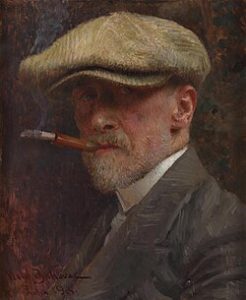
Paris and the making of an international painter

Self-portrait by Vlaho Bukovac
Bukovac’s self-portrait captures the confident cosmopolitan persona he fashioned between Cavtat, Paris, Zagreb, and Prague.

The crucial turning point was Paris, where Bukovac studied under Alexandre Cabanel at the École des Beaux-Arts. For an ambitious painter of his generation, Paris was not merely a city but a hierarchy of judgement. To succeed there meant mastering composition, anatomy, finish, and the codes through which official culture recognised seriousness. Bukovac did not arrive as a rebel determined to overturn the academy. He arrived as a disciplined student who wanted entry into the highest professional world available to painters of his time. This is important, because later attempts to present him only as a proto-modernist can miss how deeply his achievement depended on academic competence.

He absorbed the Parisian system quickly. Salon success gave him visibility, portrait commissions gave him income, and the city gave him a sense of scale. Paris also taught him performance: how an artist should present himself, how to move among patrons, and how to produce works that would satisfy both fashion and ambition. His pictures from this period and after show a painter highly responsive to texture, flesh, fabric, pose, and atmosphere. Bukovac understood that polish could itself be persuasive. He was not afraid of beauty, and that partly explains why he travelled so well between elite circles and broader public recognition.

Andromeda by Vlaho Bukovac
Mythological painting allowed Bukovac to combine academic finish, luminous colour, and theatrical storytelling.

At the same time, Bukovac was never simply derivative. The academic method gave him tools, but the sensibility that emerges in his mature work is distinctively his own: open to colour, attentive to light, and often more emotionally immediate than many purely official salon painters. Mythological works such as Andromeda reveal his taste for theatrical storytelling, while portraits show a gift for social reading. He could flatter without entirely falsifying. He could idealise, yet leave enough alertness in a face for the sitter to appear alive rather than embalmed by status.

Paris also sharpened his understanding of painting as a social language. A canvas did not merely depict; it circulated. It entered exhibitions, drawing rooms, collections, and critical conversations. Bukovac learned that technique alone was insufficient. A modern painter had to know scale, occasion, audience, and self-presentation. That capacity later made him enormously influential in South Slav artistic life, where the question was not only what to paint, but how an entire art culture should be organised, displayed, and publicly valued.

What Bukovac learned from success

Success in Paris taught Bukovac that art was a public system, not only a private calling. Painters needed institutions, exhibitions, critics, patrons, and networks. This lesson would matter enormously when he later worked in Zagreb and Prague. He was not only painting canvases; he was participating in the building of modern art culture in the lands to which he remained attached. That role is one reason his significance extends beyond aesthetic judgement. He helped carry metropolitan standards into a region still organising its cultural institutions under late imperial conditions.

He also learned that visibility carries a price. Once a painter has success, he must decide whether to remain a producer of desirable surfaces or become something larger: a teacher, organiser, and cultural force. Bukovac chose the larger path. That decision helps explain both the breadth of his influence and the conflicts that later followed him. Serious art culture is never made only through admiration. It is also made through disagreement, authority, and the reshaping of expectations.

Paris therefore gave him more than a career. It gave him a model of how culture becomes public infrastructure. When he later moved through Zagreb and Prague, he carried with him not only a painter’s hand but a metropolitan understanding of what institutions, audiences, and prestige could do. This is one reason Bukovac’s life is so revealing for the broader history of the region. He was a conduit through which a global centre entered a smaller cultural sphere without merely dominating it.

The Adriatic return: Cavtat in memory and in paint

The Ringstrasse Vienna by Vlaho Bukovac
Bukovac was never only a local painter; works such as his Vienna scenes show a career lived on a central-European scale.

For all the glamour of Paris, Bukovac returned repeatedly to Cavtat. The return was not nostalgic in a simple sense. It was practical, emotional, and symbolic at once. He remained bound to family and to place, and he also understood that a successful international career could be anchored and legitimised through visible contributions at home. The house in Cavtat preserves wall paintings and domestic traces that make this especially vivid. One sees not an abstract genius but a man who inserted art back into the rooms and routines of his origin.

Cavtat mattered to Bukovac as a visual reservoir. The quality of southern light, the limestone surfaces, the vegetation, and the maritime edge all fed his imagination. Yet what he brought back from Paris was not simply a better technique for painting familiar motifs. He brought an enlarged understanding of what a local place could mean on canvas. The Adriatic in Bukovac is not provincial scenery waiting for metropolitan validation. It becomes part of a cultivated pictorial world. In this respect he performed a cultural translation: he showed that a painter formed in Cavtat could represent society, allegory, and identity at a level recognisable across Europe.

Before the Toilet Mirror by Vlaho Bukovac
Bukovac’s studio practice moved easily between intimacy, polish, and bravura surface effects.

His relation to the Dubrovnik region therefore belongs to a broader story about post-Ragusan identity. After the end of the Republic of Ragusa, the region’s elite and educated classes had to renegotiate what prestige meant under Habsburg and wider European conditions. Bukovac contributed to that renegotiation through art. He did not restore the old republic, but he offered another path to distinction: cultural excellence that was outward-looking yet locally grounded. That is one reason he remained important to later generations of Dalmatian and Croatian intellectuals who wanted proof that the region could produce figures of European rank.

The return to Cavtat also complicates the idea of centre and periphery. Bukovac did not simply bring metropolitan culture back to a passive town. He activated something already present there: a readiness to absorb and reinterpret prestige. Cavtat’s later cultural self-understanding owes much to this. The town could now claim not only scenic charm and historical lineage but a living connection to European art. Through Bukovac, local memory gained colour, institutional seriousness, and a face the wider world could recognise.

What he returned with was not simply technique, then, but scale. He enlarged what Cavtat could imagine itself to be. He made it possible for a small Adriatic town to be read not only as beautiful or historical, but as productive of culture at a European level. That is why his legacy in Cavtat is not passive commemoration. It is structural. He changed the size of the town’s own cultural horizon.

Readers exploring the town beyond its promenade will notice how naturally Bukovac fits into a wider cultural itinerary that also includes the women who sustained Cavtat’s artistic and memorial life and sites such as the Račić Mausoleum. Bukovac is central, but he is not solitary. He belongs to an ecosystem of memory.

Zagreb, Prague, and the politics of modern culture

Bukovac’s importance in Zagreb is often summarised by calling him the founder of modern Croatian painting. The phrase is true, but incomplete. What he helped create was not just a new style; it was a new expectation that art in the South Slav lands could be institutionally organised, publicly debated, and socially consequential. He brought prestige, technical authority, and an understanding of exhibition culture. He also brought conflict, because serious cultural modernisation always creates factions. Questions of taste, hierarchy, generational change, and national representation all gathered around him.

He arrived in Zagreb not simply as an admired painter but as someone who had seen how a modern art world operated. That mattered enormously in a setting where cultural infrastructure was still being consolidated. Bukovac represented proof that international standards need not remain foreign possessions. They could be learned, adapted, and used to raise local ambition. This is why his presence in Zagreb was so catalytic. He altered expectations. Once he had done so, earlier modesties became harder to defend.

Later, in Prague, Bukovac continued his academic career at a major level, teaching and painting in one of central Europe’s most intellectually charged cities. This phase confirms that his reputation was not a local exaggeration. He could function within demanding artistic environments far from the Adriatic. Yet his mobility also sharpened the meaning of his origins. The fact that Cavtat claimed him, and still claims him, matters precisely because the claim is justified. Bukovac did not become important merely near home; he became important away from it and carried that importance back.

Prague also completed the image of Bukovac as a truly European painter rather than a successful provincial expatriate. In that city he entered another dense artistic system, one with its own institutions, rivalries, ambitions, and intellectual seriousness. That he could work there at a high level tells us something decisive: the Adriatic beginning had not limited him. It had prepared him for breadth. Yet the emotional and symbolic logic of his career continued to bend back toward Cavtat, because origins became more meaningful, not less, once achievement had been secured elsewhere.

Year Event Why it matters
1855 Born in Cavtat Places his life within the Dubrovnik and Konavle historical world.
1870s Travels and early struggles abroad Shows the migrant and maritime background behind his later ambition.
Late 1870s–1880s Studies in Paris under Cabanel Gives him academic authority and access to the Salon system.
1890s Important role in Zagreb cultural life Helps shape the institutional development of modern Croatian art.
1900s Works in Prague Confirms his central-European stature beyond a regional frame.
1922 Dies in Prague Ends a transnational career that remained tied to Cavtat in memory and reputation.

Painting society, painting identity

Portrait painting by Vlaho Bukovac
The painter’s reputation rested not only on biography but on a rare ability to move between portraiture, genre painting, and elegant finish.

Bukovac’s greatest strength may have been his ability to paint society without making society look dead. Portraiture in the late nineteenth century could easily become an exercise in status display. Bukovac often accepted that function; patrons wanted evidence of taste, rank, and civility. But he also gave faces animation and psychological tact. He understood clothing, gesture, and social theatre. He saw that portraiture was about reading a person’s desired public self and then composing that self persuasively.

This made him invaluable in a region where the educated and affluent classes were trying to define themselves between imperial loyalties, local memory, and emergent national cultures. A portrait by Bukovac could therefore do more than flatter an individual. It could announce belonging to a modern world of culture. When he painted fellow members of the region’s intellectual elite, he was effectively assembling a gallery of Adriatic modernity.

There is also a wider cultural lesson here. Portraiture, in Bukovac’s hands, became a way of organising social dignity. He did not simply paint what people looked like. He painted what classes, professions, and families wanted themselves to mean. This is why his portraits remain valuable historical documents even when read beyond purely aesthetic terms. They show how a region imagined cultivated authority, femininity, intellectual seriousness, and public grace during a period of rapid cultural transition.

Portrait of Baltazar Bogišić by Vlaho Bukovac
His portrait of Baltazar Bogišić also shows how the artistic and intellectual elite of Cavtat could be pictured within the same cultural world.

The portrait of Baltazar Bogišić is a useful example. It is not only a likeness of a jurist and scholar; it is a visual statement about dignity, seriousness, and cultivated authority. Seen from Cavtat today, the image suggests something larger: that this small town produced, within two generations, figures who mattered to law, painting, and learned culture across Europe. Bukovac was both participant and witness in that story.

His work therefore belongs to the history of self-definition as much as to the history of art. Bukovac painted the faces through which a modern society wished to recognise itself. In doing so, he helped stabilise an image of refinement and seriousness for a region often read from outside through stereotypes of picturesque backwardness. He replaced that condescension with evidence.

That is part of why his achievement has lasted so well. Bukovac’s paintings continue to reward visual attention, but they also carry sociological force. They show an Adriatic society in the act of picturing itself upward. The faces are not merely beautiful or accomplished. They are aspirational documents of a region trying to establish its cultural weight under modern conditions.

Bukovac House and the material survival of memory

One of the reasons Bukovac remains unusually accessible is that his memory survives materially. Bukovac House in Cavtat is not a symbolic reconstruction built long after the fact. It is a place saturated with direct connection: domestic interiors, family atmosphere, wall paintings, objects, and a scale that resists heroic abstraction. Many famous artists survive only through museum labels and overreproduced masterpieces. Bukovac survives through rooms. That changes how a visitor understands him. The artist reappears as a son, husband, father, neighbour, and returnee, not only as a name in art history.

Signature of Vlaho Bukovac
Even Bukovac’s signature became part of a public artistic identity carefully built across Europe.

For Cavtat itself, this matters profoundly. The town’s historical identity is sometimes flattened into postcard categories, or else into a satellite relation to Dubrovnik. Bukovac complicates that simplification. He gives Cavtat an artistic biography of its own. Anyone already interested in the town’s deeper layers will find that Bukovac adds the historical depth behind the modern surface. He is proof that the town’s confidence is older than tourism.

The museum context also helps correct a misunderstanding. Bukovac was not important because he was born in Cavtat and then made good elsewhere. He was important because he repeatedly returned, contributed, left work behind, and became part of the town’s self-interpretation. That reciprocity between place and person is what makes him a historical figure rather than simply a famous native.

The house also offers something rarer than information: proportion. In an age of oversimplified cultural consumption, where great figures are flattened into a few captions and photographs, Bukovac House restores duration and domestic complexity. It reminds the visitor that art is made from family structures, habits of work, financial anxieties, ambition, and return. That is exactly why the museum matters so much within Cavtat. It keeps artistic greatness from becoming abstract.

Bukovac, women, family, and the afterlife of reputation

No serious account of Bukovac should end with the solitary male genius. His afterlife in Cavtat was also sustained through family memory, especially through the women who preserved, interpreted, and opened aspects of that memory to the public. The history of Bukovac House is therefore inseparable from the wider question of how artistic legacies survive in Adriatic towns: not only through public monuments and scholarship, but through daughters, domestic archives, inherited objects, and the slow conversion of family space into civic memory.

This matters because it shifts the story from simple biography to cultural continuity. Bukovac painted, travelled, succeeded, and taught. But others helped make that achievement legible to later generations. Cavtat’s understanding of Bukovac was not automatically guaranteed by his talent. It had to be maintained. Once again, the town reveals itself not as a passive backdrop to greatness but as an active keeper of significance.

That is also why Bukovac remains unusually alive in Cavtat compared with many historic cultural figures elsewhere. He is not trapped in the cold register of prestige alone. He survives through a human chain of remembrance. The domesticity of his legacy is not a reduction of his significance. It is part of its depth. Greatness here did not sever itself from household, kinship, and local attachment. It was preserved through them.

Readers who want to understand this female continuity more fully should also read The Women of Cavtat, because Bukovac’s public afterlife makes far more sense when placed beside the women who protected houses, memory, and civic interpretation.

How to encounter Bukovac today

Modern readers should care about Bukovac for at least three reasons. First, he shows how the eastern Adriatic produced not only sailors, diplomats, and merchants but also artists fully capable of competing in the leading visual culture of their age. Secondly, he reveals how local identity in Dalmatia was made through movement, education, and public self-fashioning rather than through static folklore. Thirdly, he remains physically encounterable. A visitor can walk Cavtat, enter his house, see his work, and grasp the social world that first trained his eye.

Those who want to understand the wider region beyond a simple day-trip itinerary should treat Bukovac as essential. He stands beside the jurist Baltazar Bogišić and, in a different register, beside the literary memory of Dubrovnik, as evidence that the Dubrovnik–Cavtat–Konavle area has long produced figures whose work exceeded regional boundaries. That is why his story belongs not only in art history, but in the history of the Adriatic as a zone of intelligence and ambition.

He is also a useful corrective to the way coastal places are often consumed now. Much modern travel writing privileges experience over formation, views over memory, and atmosphere over structure. Bukovac resists that flattening. Through him, Cavtat becomes not simply attractive but generative. It becomes a place that made something, trained someone, and continued to interpret him long after he left.

The central truth of Bukovac’s life is that he made elegance out of endurance. He came from a small town, learned to survive distance, mastered the academy, won patrons, shaped institutions, and still left behind a house in Cavtat where the local and the European continue to meet. For a traveller walking the waterfront today, that may be the most valuable lesson of all. Cavtat is not interesting because it is quaint. It is interesting because it has repeatedly produced people who knew how to address the world.

And Bukovac still addresses it. He does so through paintings, certainly, but also through the civic confidence his career gave to the town. He remains proof that the Adriatic edge was never merely a margin. Under the right conditions it could become a point of departure into the heart of European culture. Cavtat produced a European painter not by accident, but because it already contained the habits of adaptation, aspiration, and memory from which such a painter could emerge.

Frequently Asked Questions

Why is Vlaho Bukovac important to Cavtat?

Because he turned Cavtat from a beautiful place of origin into a culturally consequential place of origin. His career gave the town a durable link to European art history.

What is the best place to learn about him in Cavtat?

Bukovac House is the essential starting point because it preserves domestic space, memory, and direct traces of the artist’s life.

Was Bukovac only important in Croatia?

No. His training in Paris and career in Prague confirm that he belonged to a wider European artistic world, not just a regional one.

What kind of painter was he?

He was especially important as a portraitist and academically trained painter who combined polish, colour, and social intelligence with a larger role in shaping modern Croatian art culture.

How does Bukovac change the way visitors see Cavtat?

He makes the town feel historically larger. Instead of seeing Cavtat only as a harbour with atmosphere, visitors begin to see it as a place that produced artistic ambition, memory, and civic confidence.

Conclusion

Vlaho Bukovac matters because he turned local formation into international presence without severing the thread between the two. He was not simply a Paris-trained painter who happened to come from Cavtat. He was a Cavtat-born artist who proved that the southern Adriatic could produce cultural authority at the highest level of nineteenth-century Europe. That distinction matters because it restores agency to place. Cavtat did not merely claim him after the fact. It helped make him imaginable in the first place.

His career also explains why Cavtat should be read as more than a harbour of agreeable proportions. It is a town with an artistic memory of genuine depth, a place where domestic interiors, public identity, and European ambition still intersect. Bukovac House, his portraits, his institutional role in Zagreb and Prague, and his repeated return to the south all confirm the same point: the region’s story is not only scenic or touristic. It is cultural in the strongest sense.

To understand Bukovac properly is therefore to understand something larger about the Dubrovnik Riviera. This coastline has long produced people able to travel outward without dissolving into abstraction. Bukovac did exactly that. He became cosmopolitan without becoming rootless. He painted Europe, but he never lost the Adriatic measure of light, surface, and civic pride. That is why he endures. And that is why Cavtat, through him, remains one of the most serious small towns on the cultural map of the eastern Adriatic.

Planning an art or history-focused visit to Cavtat?

Tell Cavtat Guide your dates and interests, and we will help you build a cultural itinerary around Bukovac House, the Račić Mausoleum, and the deeper artistic layers of the Dubrovnik Riviera.

Send an inquiry

Keep exploring...

A Week at Sea Between Dubrovnik and Hvar

```html A Week on a Crewed Yacht in Croatia — Life at Sea Between Dubrovnik and Hvar A seven-night charter in the southern Adriatic is rarely...

Luxury Catamarans vs Sailing Yachts — Choosing the Right Yacht for Croatia

Best Luxury Catamaran Charters in Croatia for Stylish Island-Hopping Luxury catamaran charters in Croatia work because they fit the coast’s natural logic. The Adriatic rewards...

Places to travel

Related Articles

A Week at Sea Between Dubrovnik and Hvar

```html A Week on a Crewed Yacht in Croatia — Life at Sea Between Dubrovnik...

Luxury Catamarans vs Sailing Yachts — Choosing the Right Yacht for Croatia

Best Luxury Catamaran Charters in Croatia for Stylish Island-Hopping Luxury catamaran charters in Croatia work...

Cavtat vs Dubrovnik — Where Should Yacht Travellers Stay?

An editorial comparison of Cavtat and Dubrovnik for yacht travellers, covering marina feel, hotel rhythm, dining, transfers, atmosphere and who each base suits best.

The Dubrovnik Riviera Property Market — Why Buyers Are Looking Beyond Dubrovnik

Dubrovnik is one of those cities that can distort a property search before it begins. It is so visually complete, and so famous, that outsiders often assume the rational thing is to buy as close to the walls as possible....

Buying Land on Croatian Islands — Opportunities for Development

Buying land in Croatia can seem like the most seductive form of property ownership. A buyer imagines total control: the right parcel, the right architect, the right sea view, a house shaped exactly to personal rhythms. O...

How Much Does It Cost to Charter a Yacht in Croatia?

A detailed guide to Croatia yacht charter costs, from catamarans and skippered sailing yachts to crewed motor yachts, with pricing logic, extras, seasonality and route planning.

Buying Property in Croatia as a Foreigner — What International Buyers Should Know

A practical editorial guide for international buyers navigating coastal property purchase in Croatia, from ownership rules and reciprocity to taxes, due diligence and lifestyle strategy.

The Women of Cavtat: Jelka Miš, Jelica Bukovac, and the Račić Women

Cavtat is often introduced through its most visible male names. It becomes far richer,...