

Cavtat is often introduced through its most visible male names. It becomes far richer, and far more accurate, when read through the women who preserved skill, carried memory, and shaped how the town presents itself to the world.
Best way to read this story: as a correction to the usual Cavtat narrative
Key figures: Jelka Miš, Jelica Bukovac, Marija Račić Banac, and Mare Račić
Main takeaway: Cavtat’s heritage survived through female labour, preservation, and intention, not through monuments alone
Cavtat is usually narrated through a familiar line of male names: the jurist and collector Baltazar Bogišić, the painter Vlaho Bukovac, the sculptor Ivan Meštrović by way of the mausoleum, the shipping families whose wealth altered the town’s skyline, the public men whose reputations travelled well beyond the southern Adriatic. None of those names should disappear. But the town becomes far more intelligible once its women are moved from the margins to the centre. The gain is not ideological decoration. It is historical accuracy.
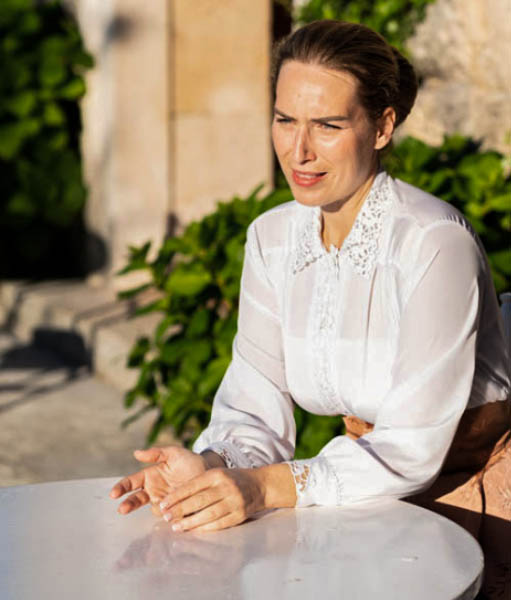
Jelka Miš, Jelica Bukovac, and the women of the Račić family reveal a different structure of local life. Through teaching, embroidery, collecting, painting, remembrance, patronage, and family stewardship, they alter how Cavtat ought to be understood. The town stops looking like a place made by notable men with supportive women in the background. It becomes what it more accurately was: a place where women played decisive roles in cultural transmission, artistic continuity, and the public afterlife of memory.
This matters to travellers because local history is not improved by token additions. It is improved by better structure. Once you begin reading Cavtat through its women, familiar landmarks change. The Bukovac House becomes not only the house of a master painter, but also a house preserved, interpreted, and emotionally carried by daughters. Embroidery stops appearing as decorative “tradition” and begins to look like educational labour, civic organisation, and museum formation. The Račić Mausoleum ceases to be only a monument of family tragedy and becomes a story of grief, will, patronage, and memorial intention. These are not side notes. They are organising truths.
They also correct a wider misunderstanding about towns like Cavtat. Heritage is often presented as if it simply survives by virtue of age and charm: old houses remain, collections remain, monuments remain, costume remains. In reality, heritage survives because someone carries it forward. Someone teaches the stitch. Someone keeps the objects. Someone refuses to let the house fall silent. Someone converts grief into form. The women in this article do not merely supplement Cavtat’s history. They help explain how that history remained public at all.
Best way to understand this article: these women are not decorative additions to Cavtat’s story. They are part of the mechanism by which memory, craft, and cultural authority remained visible across generations.
I. Jelka Miš and the discipline behind tradition
Jelka Miš deserves far more attention than she usually receives in casual visitor narratives. She is remembered as a teacher, a leading figure in the preservation of local embroidery, and a woman whose ethnographic work contributed directly to museum life. That is already significant. But her deeper importance lies in the kind of work she represents. Jelka was not merely admiring heritage or collecting attractive objects. She was helping to build a system of knowledge: patterns, techniques, standards, teaching structures, and institutional continuity.

The Konavle embroidery tradition is often admired visually by travellers, especially when encountered in folklore performances or museum settings. Yet visual admiration without context is thin. Jelka gives the tradition structure. She is associated with the disciplined teaching of embroidery and with the organisational work that allowed local textile culture to remain legible to later generations. What visitors now read as “heritage” survived because women organised the transmission of skill with seriousness.
That seriousness matters. Handwork of this kind does not preserve itself by virtue of beauty alone. It survives through repetition, correction, patience, and standards. Someone has to distinguish good work from careless work. Someone has to decide what deserves keeping. Someone has to teach girls and young women not only how to make something, but why exactness matters. In that sense, Jelka represents a form of cultural authority that is often underestimated because it is associated with domestic arts. But on the Adriatic, and especially in Konavle, such work was not merely domestic. It was educational, social, and civic.

One reason Jelka matters so much is that embroidery in Konavle was never only private handiwork. It carried social meaning, family memory, and public representation. Costume, lace, and stitch work moved between household life and broader civic display. They signalled training, discipline, local belonging, and forms of beauty that were recognisable within the community. When regional institutions now present embroidery as one of Konavle’s signature cultural forms, they are inheriting a framework sustained by women who understood that preservation requires method. Without such labour, beautiful objects remain isolated. With it, they become a language.
There is also a modern lesson here for travellers. We often consume “tradition” as atmosphere while forgetting the pedagogical labour behind it. Jelka forces us to see the invisible hours: teaching girls, collecting examples, distinguishing careful work from imitation, and making the region legible to itself through material culture. For a place like Cavtat, which now receives international visitors daily in season, that legacy is foundational. It preserved one of the strongest visual signatures of the wider region.

Embroidery also belongs to a broader female economy of value. It shaped how dress was read, how households presented themselves, how ritual occasions were marked, and how local identity was made visible. In that sense, it connected women’s labour to public culture far more directly than many modern summaries suggest. The embroidered object was not just pretty. It was social evidence: of patience, skill, discipline, family care, and regional belonging.
II. Jelica Bukovac and the burden of artistic inheritance
If Jelka helps us understand transmission through craft and teaching, Jelica Bukovac illuminates a different problem: what it means to live artistically inside a famous father’s shadow while also protecting his afterlife. She is remembered as a painter and as one of the daughters through whom the public memory of Vlaho Bukovac remained active. That dual role, artist and custodian, is precisely what makes her important.

Women in artistic families are often written into history through sacrifice: they supported, they inherited, they preserved. With Jelica, the truth is more complex. She studied painting seriously and belongs to the artistic life that radiated outward from the Bukovac name. She also appears in the emotional archive of Bukovac’s world as child, daughter, model, and later interpreter of his presence. That multiplicity is worth insisting upon. It prevents the easy reduction of female artistic figures either to “forgotten genius” or to “dutiful daughter”. Jelica was both maker and mediator, and that combination tells us something profound about Cavtat itself. In a small cultural town, artistic life does not survive through creation alone. It survives through care.
The Bukovac House is one of Cavtat’s essential visits, but it is often approached too narrowly as a male-master site. It is more accurately understood as a house of family continuity, and that continuity was shaped decisively by women. The daughters who helped preserve the house and its memory did more than keep objects in place. They made an artist available to future Cavtat, and therefore to future travellers. Without them, the house might have remained a private relic rather than a working site of memory.

This matters because house museums are not neutral containers. They are edited spaces. Someone decides what survives, what is shown, how intimacy becomes public, and what emotional tone a visitor will inherit. In the case of Bukovac’s house, the female role in preservation helps us understand the building less as a frozen monument and more as a carefully carried archive. The visitor enters not only a painter’s world, but a world that daughters helped hold together after him.
III. The Račić women: grief, will, and memorial form
The Račić Mausoleum is among the most powerful sites in Cavtat, but it is too often described in a flattened way: famous family, celebrated sculptor, beautiful stone, tragic deaths. The history is more specific, and more female, than that summary suggests. The names around the monument include Mare Račić, the mother, and Marija Račić Banac, the daughter, whose place within the family tragedy and memorial will gives the mausoleum a much more exact human structure. In this sense, the building is not only a family monument. It is also a structure of female grief and intention.

Marija Račić Banac matters because memorial architecture does not arise only from artistic genius. It arises from relationships, legal acts, grief, patronage, and decisions about what will remain after loss. Mare Račić, meanwhile, stands behind the continuation of family memorial intention after extraordinary sorrow. To read the mausoleum without these women is to misread it fundamentally. The building may be sculpted by one artist, but it is emotionally authored by more than one hand.
One reason the Račić women are so important is that patronage has historically been narrated as secondary to art itself. Yet in places like Cavtat, patronage determines what enters the landscape and what survives inside it. The mausoleum did not appear by aesthetic accident. It exists because grief, resources, relationships, and intention were concentrated into form. That is a kind of authorship, even if not authorship in stone-cutting terms. Marija Račić Banac and Mare Račić therefore belong within the creative history of Cavtat, not outside it.
For visitors, this changes the experience of the site. The walk uphill is no longer only an ascent to architecture. It becomes a passage into a family drama in which emotional and legal agency mattered. The building reads differently once you know that. It becomes less decorative, more human, and more exacting in its sadness.
| Figure | Field of influence | Why she matters to Cavtat |
|---|---|---|
| Jelka Miš | Embroidery, teaching, collecting, museum formation | She helped organise the preservation and transmission of Konavle material culture. |
| Jelica Bukovac | Painting, artistic memory, gallery continuity | She linked creative practice with the preservation of Bukovac’s public legacy. |
| Marija Račić Banac | Patronage, memorial intention, social memory | She is central to the story behind the Račić Mausoleum and Cavtat’s memorial landscape. |
| Mare Račić | Family legacy, memorial continuation | She embodies the maternal and dynastic grief that shaped one of Cavtat’s defining monuments. |
IV. Women and the public life of Cavtat
These biographies also reveal something wider about the town. Cavtat’s public life has long depended on women’s labour in forms that are easy to underestimate: education, language, sociability, representation, domestic management that supports public culture, and the conversion of private memory into civic memory. In places with strong family histories and visible heritage sites, women often function as interpreters between house and town, mourning and monument, craft and institution. Cavtat is no exception.
This is why female biography should not be quarantined into a “women’s history” corner. It belongs at the centre of regional understanding. A traveler who has visited the Bukovac House, seen Konavle embroidery, and climbed to the Račić Mausoleum has already moved through this history, whether it was explicitly named as such or not. The task is to make that structure visible.
It also explains why certain apparently small cultural forms matter so much in Cavtat. The domestic interior, the carefully kept textile, the remembered family room, the letter, the portrait, the devotional gesture, the local association, all of these belong to the public life of a place even when they emerge from private female work. Town culture is not made only in squares, courts, or ports. It is also made in the sustained labour that allows public memory to have texture.
V. How these women change the traveler’s map
Once these figures are restored to view, Cavtat becomes a different place to walk through. The visitor notices not only masterpieces or grand names, but systems of care. A museum collection implies a donor and organiser. A costume implies teachers, girls, standards, and preservation. A family house turned gallery implies daughters who refused oblivion. A mausoleum implies not just an architect or sculptor, but those whose grief and decisions made memorial architecture possible. This makes the town feel denser and also more intimate.
It also creates a better kind of regional tourism. Instead of consuming heritage as a series of objects, travelers begin to see it as a chain of relationships. That shift is good for readers and good for places. It treats culture as lived and carried, not merely displayed. It also makes the town more memorable. Instead of leaving with a list of sights, the visitor leaves with a structure of meaning.
There is another reason to write about these women now. In the age of rapid destination branding, places are constantly reduced to visual shorthand. Cavtat risks being flattened into “pretty harbour near Dubrovnik” unless its deeper structures are repeatedly explained. These figures help resist that flattening because they anchor the town in continuity rather than scenery alone. They speak of schools, studios, associations, family archives, wills, letters, collections, and inherited skill. These are slow forms of life. They make a destination difficult to summarise cheaply, which is very often a sign that it is worth understanding properly.

They also connect usefully with current public programming. Local storytelling events that place figures like Jelka Miš and Marija Račić Banac back into evening experience are doing something more important than entertainment. They are making the gendered structure of local memory audible again. For visitors, that can be an elegant entry point into a more substantial historical understanding.
Practical cultural logic for visitors: read Cavtat not only through famous names and monuments, but through the women who taught, preserved, opened, donated, remembered, and commissioned.
VI. How to experience this history in Cavtat now
Travelers who want to read Cavtat through its women should do more than collect sites. They should pay attention to the order in which those sites speak to one another. Begin with the Bukovac House, where artistic inheritance and female preservation meet directly. Continue through the wider town and into the textures of Konavle heritage, where embroidery and textile culture reveal how female labour organised visual identity. Then climb to the Račić Mausoleum, where patronage, grief, and memorial authorship give the town one of its most emotionally serious spaces.
Even the ordinary walk between these places becomes more meaningful once this structure is recognized. The promenade is no longer only scenic. It becomes the thread linking house, institution, domestic art, and public monument. The harbor is no longer just a beautiful foreground. It is the maritime setting within which families, teachers, daughters, widows, and patrons moved through real lives whose traces still shape the town.
That is the version of Cavtat worth carrying forward. It is historically more accurate, ethically more serious, and more rewarding for travelers who want a place to open rather than merely charm. Once these women are in view, the town’s familiar landmarks no longer stand alone. They are held inside a richer civic story, one stitched, painted, interpreted, and remembered by women whose work deserves to be read at the centre of the Adriatic map.
Conclusion
Jelka Miš, Jelica Bukovac, and the Račić women do not simply diversify Cavtat’s historical cast. They change the meaning of the town. Through them, heritage becomes teaching, art becomes care, patronage becomes authorship, and memory becomes active work rather than passive inheritance. Their stories reveal a Cavtat made not only by famous men and visible monuments, but by women who taught, preserved, painted, decided, mourned, and institutionalized culture.
The gain is not only historical. It is experiential. The town becomes harder to reduce and therefore more worth visiting. You do not leave only with images of a harbour or a mausoleum. You leave with a clearer sense of how a small Adriatic town sustains itself through transmission, through daughters, through teachers, through patrons, and through the women who made sure memory remained public rather than private. That is not an optional layer of interpretation. It is one of the keys to the place itself.
Want to experience Cavtat beyond the surface?
This story comes alive properly when walked. Join our Historic Cavtat Walking Tour to explore the town through its hidden narratives from Bukovac House and Konavle heritage to the Račić Mausoleum and the women who shaped its memory.