

Updated for 2026
Main takeaway: A luxury Adriatic catamaran charter succeeds because it makes Croatia unusually easy to inhabit: stable living, generous outdoor space, direct swimming access, and a week shaped by calm movement rather than strain.
Best for: families, couples, mixed-age groups, and first-time charterers who want privacy without losing sociability.
Best route logic: Start in Dubrovnik or Cavtat, then move through Šipan, Mljet, Korčula, and Hvar for a southern itinerary that feels rich rather than rushed.
A luxury Adriatic catamaran charter is rarely chosen because it is fashionable. It is chosen because it removes friction. That may sound less romantic than the usual charter language of blue water, polished teak, and sun-drenched lunches, but it is closer to the truth. By the time someone is seriously researching a Croatia yacht charter, they are usually beyond the stage of wanting seduction alone. They want clarity. They want to know how the week behaves once the photographs stop speaking for it.
How does breakfast feel when the yacht is still? How much privacy does a catamaran actually create for two couples travelling together? Does the beam genuinely improve comfort for children and older relatives, or is that simply one of charter’s most persistent sales phrases? Is the experience more like sailing, more like a floating villa, or somewhere in between? These are the questions that matter, because a catamaran is not really bought as an object. It is bought as a way of making the Adriatic legible.
That is the central advantage of the format. Catamarans make the Croatian coast easier to inhabit. They turn short passages into gentle transitions rather than events. They allow several versions of the same holiday to happen at once on one platform. One guest can read forward with coffee. Another can swim. Children can colonize the stern. Lunch can drift without anyone feeling confined to a single social mood. On the right route, with the right crew, the whole week acquires an ease that many travellers end up valuing more than outright theatricality.
This is why catamarans have become such a persuasive answer in Croatia. The region already offers one of Europe’s most forgiving charter geographies: islands close enough to keep movement elegant, harbours varied enough to preserve contrast, and enough sheltered water to let a week unfold without punishing pace. A catamaran amplifies those advantages. It does not fight the coast. It interprets it well.
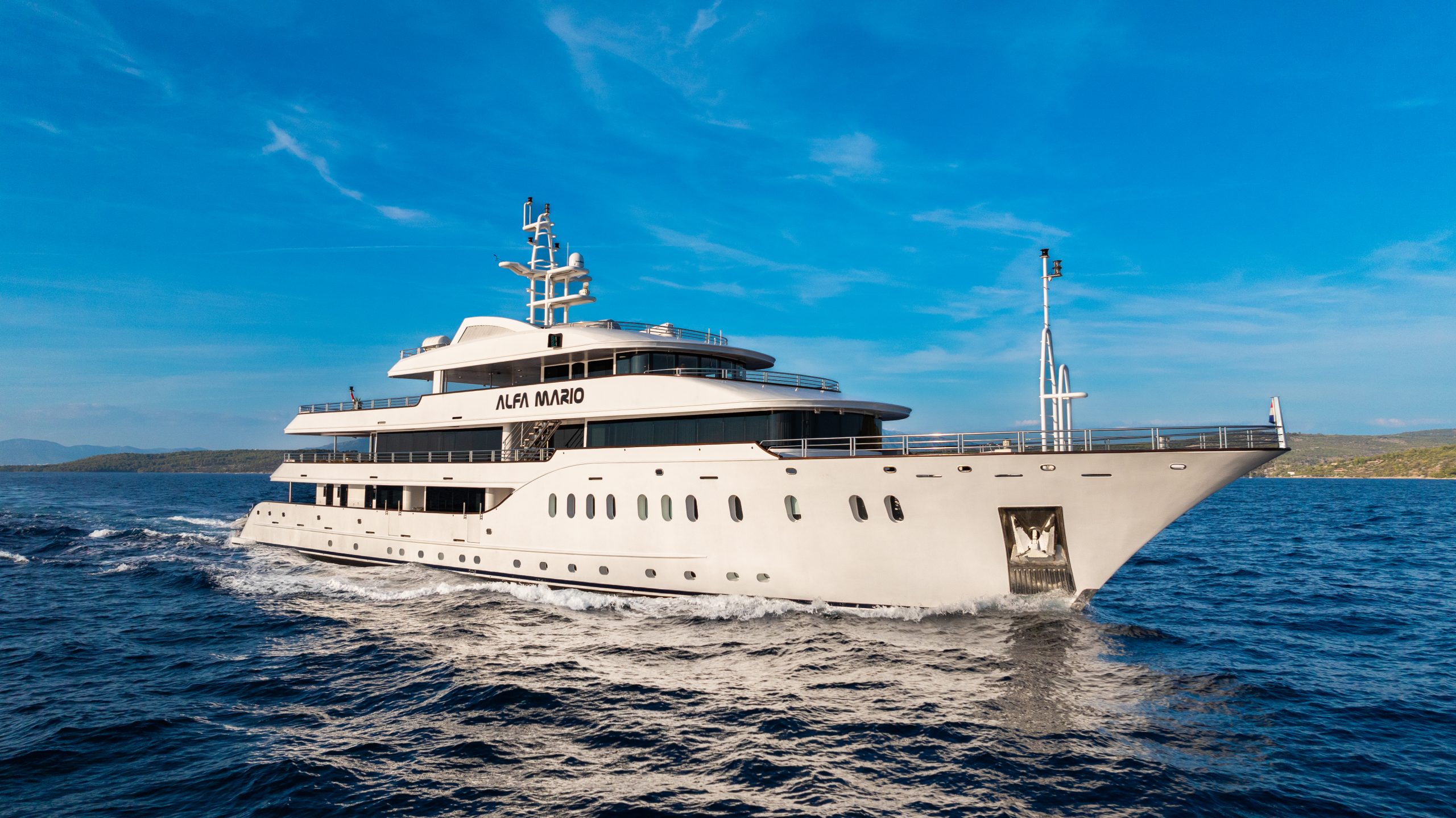
What guests are really buying
The first correction worth making is simple. Guests do not really choose catamarans because they are trying to look like sailors. They choose them because the platform makes private time at sea feel unusually manageable. Stability matters. Deck circulation matters. The fact that breakfast, swimming, sunbathing, reading, and quiet conversation can all happen without people repeatedly interrupting one another matters. These are not decorative advantages. They are the structure of the week itself.
On many yachts, especially for first-time charterers, space can become more social than guests anticipated. The group gathers because it must. The circulation encourages one dominant mood at a time. A catamaran does the opposite. It allows social life to loosen. Guests can be together without being continuously collective. That distinction becomes powerful over seven days. It is one of the reasons mixed-age groups, families with children, and friends travelling together but not identically often gravitate towards the format.
That is also why the catamaran tends to perform so well with travellers who are not habitual sailors. It feels less technical, less ceremonial, and more inhabitable. The boat does not keep insisting on itself. The lifestyle comes forward instead. In practice, that means a charter can feel less like “doing yachting” and more like slipping into a highly functional form of private coastal living.
The real proposition: guests are not buying width in the abstract. They are buying ease, stability, spatial freedom, and the ability for several small holidays to happen at once on the same platform.
Why the platform changes the mood of the week
Space at sea is never only about square metres. It is about how the day unfolds through that space. On a well-run catamaran charter, breakfast belongs to the aft deck, early reading to the bow or upper lounge, children’s energy to the waterline, and aperitifs to whichever corner catches the best light at the right hour. What the catamaran changes is not simply the quantity of usable area, but the social behavior that area makes possible.
Because the beam is generous and the vessel tends to feel more stable under moderate movement, guests are less likely to interpret every activity as a group activity. Someone can step away without disappearing. Someone can swim without turning the whole day into a swimming event. One guest can want quiet and another can want energy, and neither cancels the other out. That is a surprisingly valuable form of luxury. It does not announce itself, but it protects the mood of the week from unnecessary friction.
This helps explain why the phrase “floating villa” persists around catamarans. It is not an especially elegant phrase, but the underlying logic is sound. Catamarans import some of the emotional comfort of land-based hospitality into a maritime setting. They make guests feel settled more quickly. For many people, particularly those nervous about motion or unsure whether yacht charter is really “for them,” that reduction in perceived difficulty changes everything.
In Croatia, where the strongest charter days are often built from moderate movement rather than maximum mileage, this becomes even more persuasive. A morning swim off Šipan, a slow lunch under shade near Mljet, an easy glide towards Korčula, and a quiet evening on board can feel not like an under-programmed day, but like the correct use of the vessel. The catamaran supports exactly that kind of soft, layered rhythm.
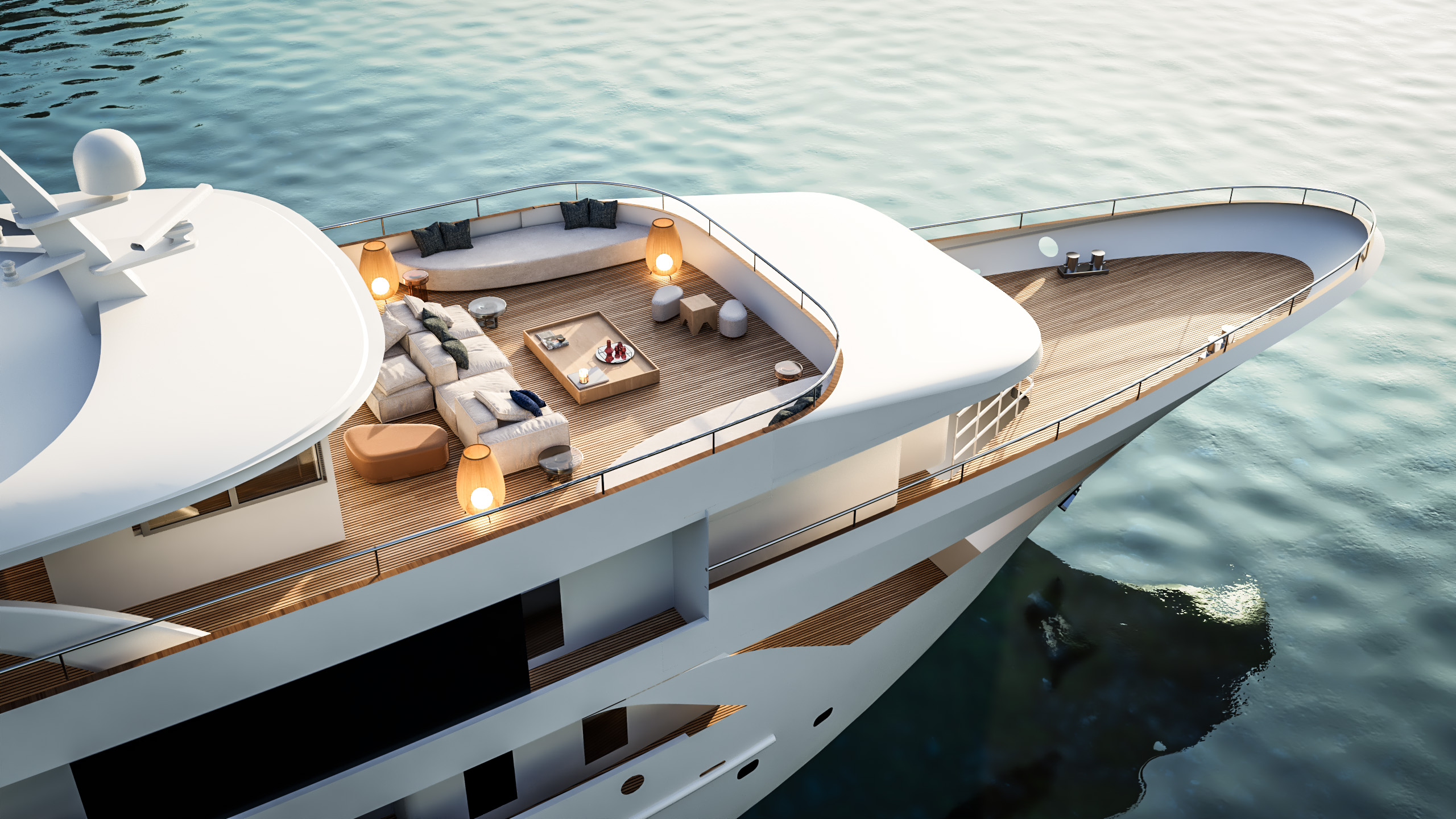
Where catamarans sit within the Croatian fleet
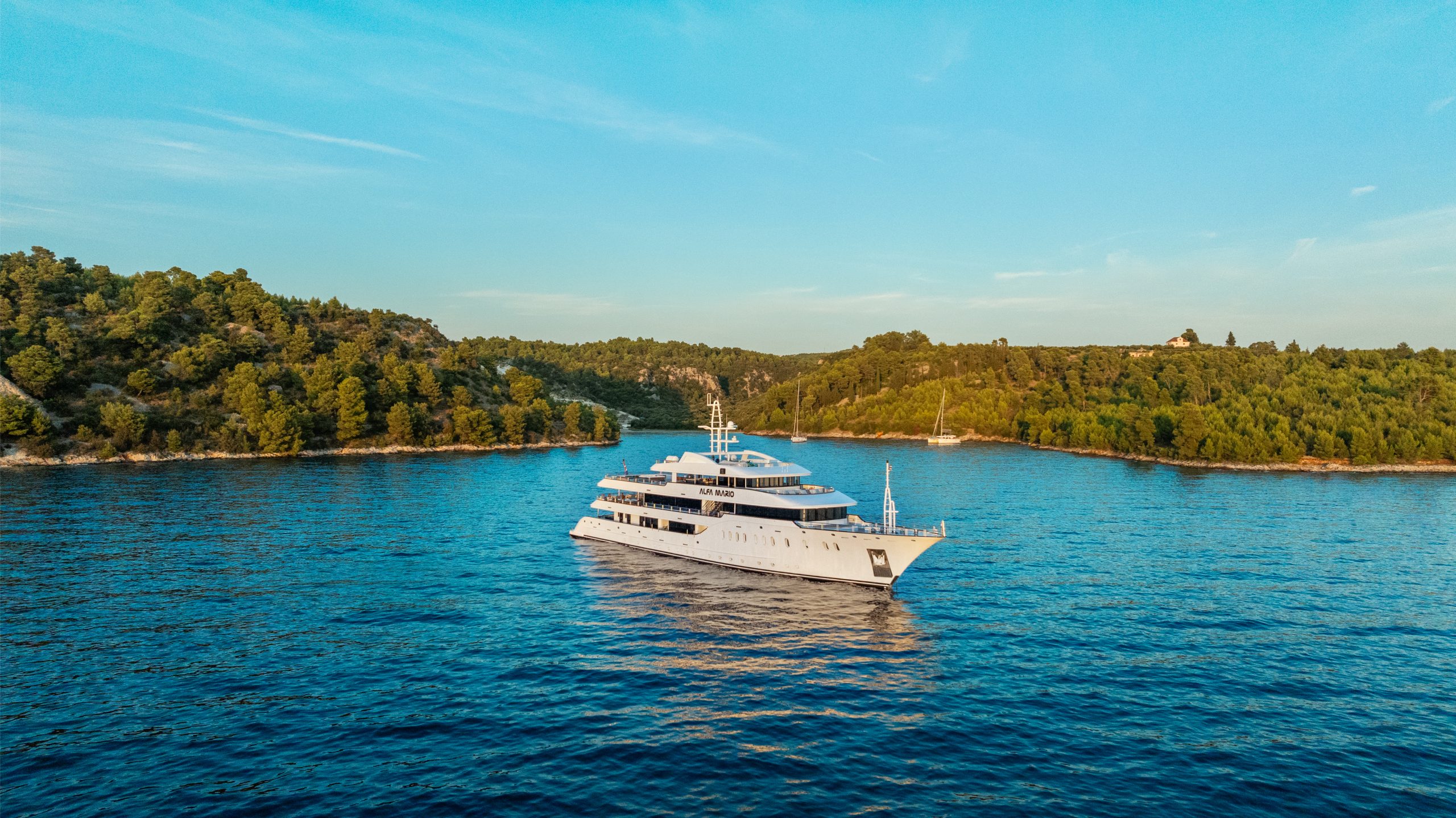
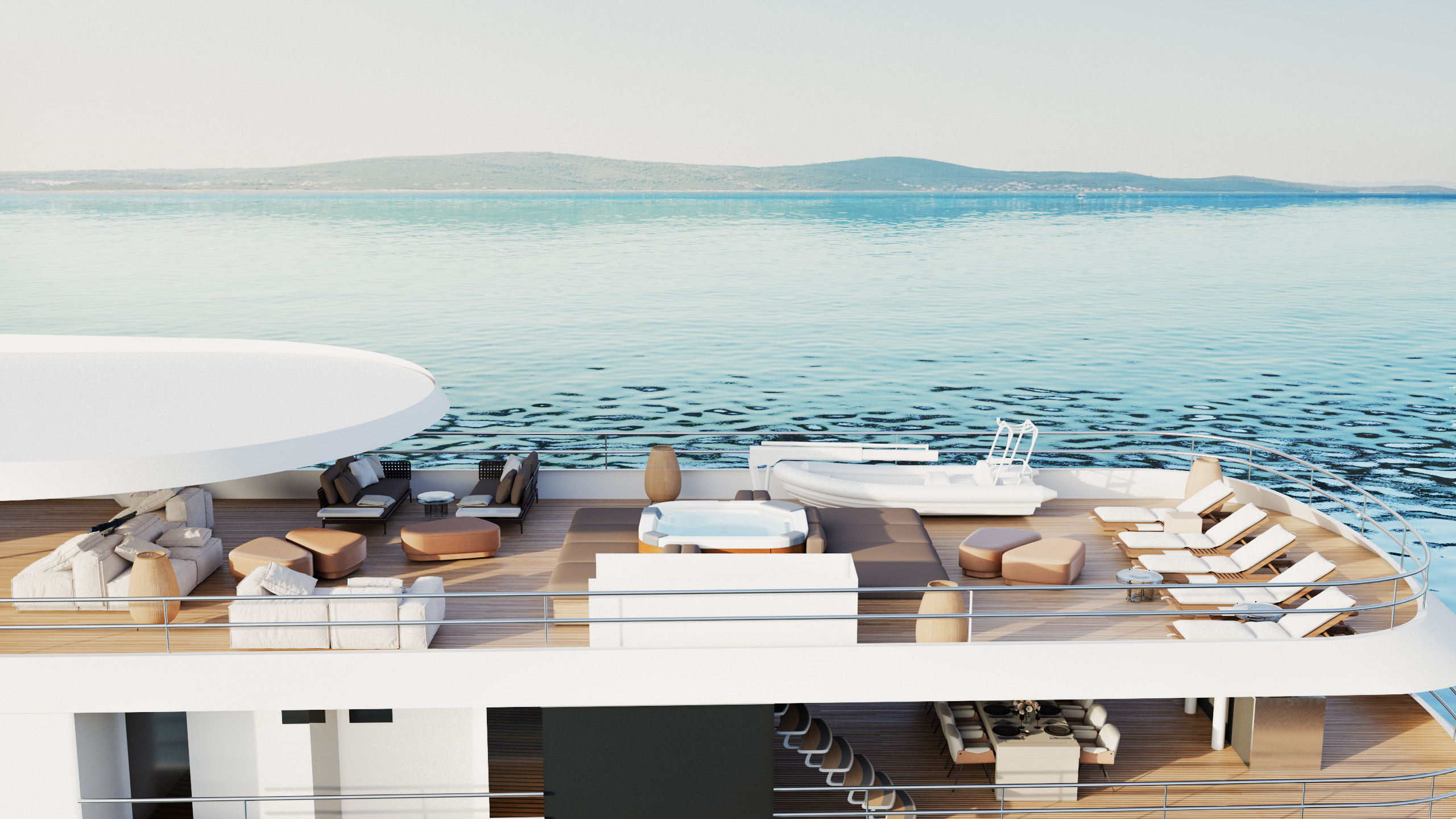
One of the easiest ways to understand a catamaran properly is to place it against the wider Croatian charter landscape. Croatia now offers a broad spectrum of yacht psychology. At one end are large-scale vessels such as Alfa Mario, which solve scale through visible amenity depth, stronger deck infrastructure, and the capacity to handle large celebratory groups without collapsing into disorder. At the other end are more intimate formats such as Nocturno, where privacy, lower guest density, and highly attentive service define the experience.
Catamarans occupy a different lane altogether. They are not lesser versions of larger yachts, nor merely sensible boats for practical travellers. They are their own answer. What they trade in is not spectacle but usability. They are especially convincing for guests who want sea access, comfort, and flexible shared living without committing either to the formality of a more classic yacht or to the social density of a larger group platform.
This is why the category performs so well for families, for two or three couples travelling together, for mixed generations, and for first-time charterers who want the romance of charter life but not all of its perceived complication. The catamaran allows the week to remain luxurious without becoming demanding. For many travellers, that is not a compromise. It is precisely the point.
Reference points that clarify the market
Even when writing about catamarans, it is useful to understand a few reference yachts because they help expose how different charter propositions really are. The point is not that a catamaran competes directly with every superyacht or gulet-style vessel in Croatia. The point is that clients make better decisions when they understand what each format is optimised to do.
| Reference yacht | Guests | Price | Why it matters |
|---|---|---|---|
| Nocturno | 12 | €85,000–€99,000/week | Shows how lower guest density changes privacy, service attention, and overall calm. |
| Premier | 22 | from €87,000/week | Illustrates residential comfort, stronger separation between guests, and high-comfort private hosting. |
| Alfa Mario | 32 | from €110,000/week | Demonstrates what large-group luxury looks like when amenities and staffing are built for scale. |
| Bellezza | 38 | €55,000–€70,000/week | Shows how atmosphere and character can matter as much as a feature list. |
These yachts are useful not because they are interchangeable with catamarans, but because they reveal what different clients are really choosing between. A guest looking for a relaxed, easy week with children may not want the same product as a host planning a thirty-person celebration. A couple seeking quiet and deck privacy may not want a floating event platform, no matter how impressive it looks in aerial photography. The right vessel is not the most luxurious one in the abstract. It is the one whose structure supports the actual life of the group.
The correct charter is not the one with the most visible luxury. It is the one that makes the week feel least forced.
The real cost logic
Price is the most discussed aspect of yacht charter and often the least intelligently understood. The base charter fee is only the opening figure. Guests also need to account for variable operating costs, provisioning, beverages, extra fuel, port fees, and VAT where applicable. Across the Croatian market, these are often handled through APA, frequently around 30% on fully crewed charters.
That structure should not be read as a deterrent. It is simply the honest architecture of private charter. In many ways it is what keeps the week flexible. Routes can change. Meals can evolve. The group can decide to stay longer at anchor or dine ashore without the whole experience becoming artificially fixed in advance. Serious clients usually appreciate this transparency because it allows the trip to be designed honestly rather than sold as fantasy.
The more useful question is never “why does this yacht cost more?” It is “what does this rate buy in lived experience?” A lower-density charter may command a high weekly price because privacy is expensive. A larger vessel may make sense because it solves the complexity of keeping a large group together without splitting across multiple platforms. A catamaran may prove particularly strong value not because it is cheap, but because it delivers a week that feels calm, spacious, and socially easy with comparatively little friction.
The crew factor: where luxury becomes real
If the yacht is the framework, the crew is the mechanism that makes the week function. This is where sophisticated travellers tend to focus once they have chartered before. They understand that luxury at sea is not really a matter of isolated features. It is a matter of smoothness. It is the feeling that things happen in the right order, at the right moment, without visible strain.
Luggage appears without being requested twice. Towels are refreshed before anyone goes looking for them. Lunch shifts by twenty minutes because the anchorage is too good to abandon. The captain quietly changes the harbour plan because the afternoon swell will make a supposedly glamorous stop less pleasant than it looks online. None of this appears theatrical. It appears inevitable. That is exactly why it feels expensive.
On catamarans, strong crew work becomes even more noticeable because the platform invites overlapping uses. Someone may already be in the water while someone else still wants coffee and silence. Children may want activity while another guest needs half an hour with a laptop. The crew’s job is to let all of that coexist without the day becoming chaotic. The vessel provides flexibility; the crew turns that flexibility into coherence.
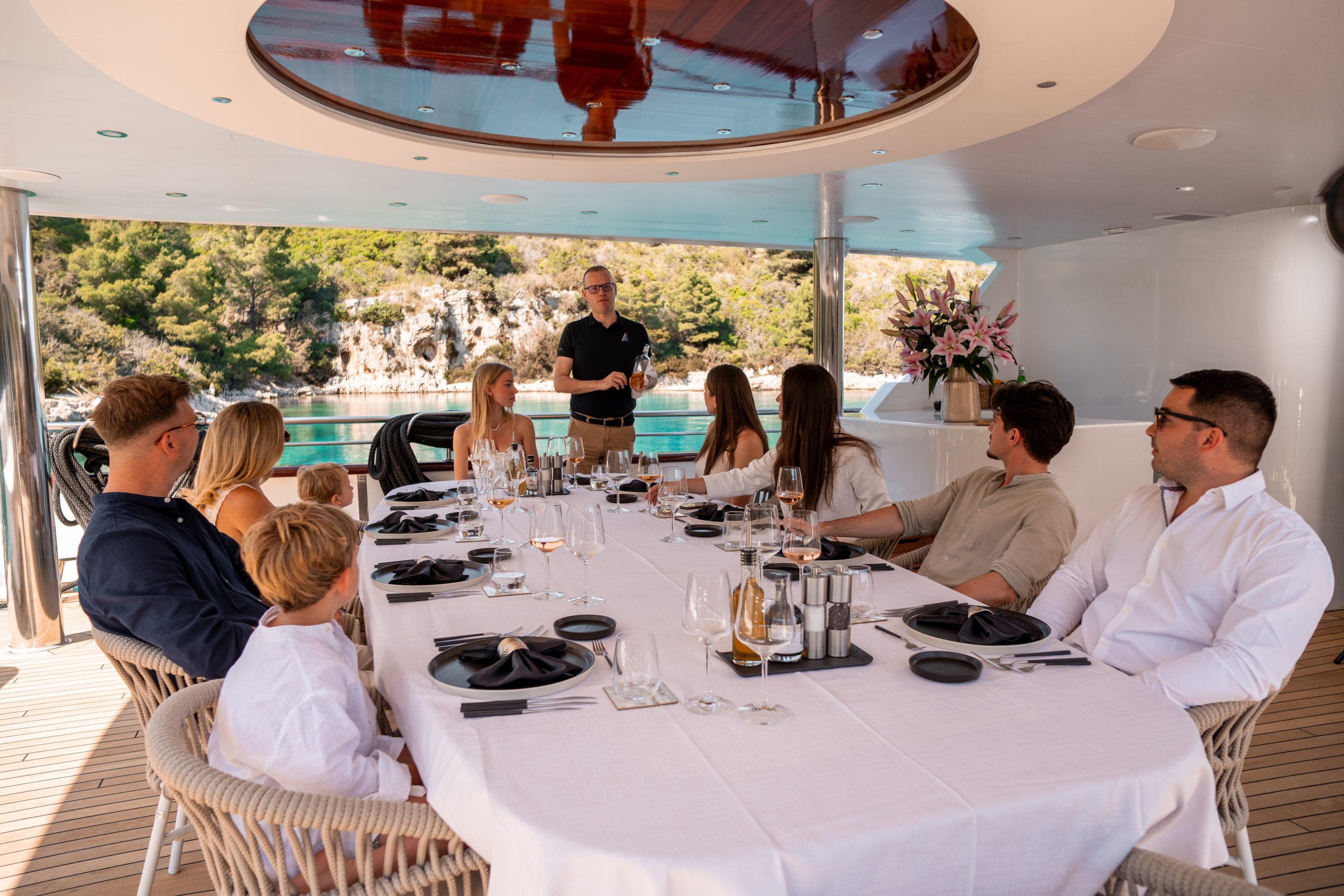
Why Croatia suits the format so well
The Croatian coast is unusually generous to private charter. Distances are short enough to avoid a transit-heavy week, yet long enough to preserve the sensation of moving properly through a region. Harbours, coves, islands, and town stops are close enough together to create flexibility without draining the guests’ energy. This is one of the deepest reasons Croatia remains so persuasive in the charter market: it offers beauty with workable logistics.
A southern route beginning around Dubrovnik or Cavtat can move through Šipan, Mljet, Korčula, and Hvar without feeling mechanically ambitious. Each location changes the emotional register. Šipan softens the pace. Mljet calms it further. Korčula gives the week architecture and civic texture. Hvar introduces contrast, sharper social energy, and a different kind of summer theatre. That variety matters because it prevents the charter from collapsing into one long sequence of similar blue-water scenes.
But the strength of Croatia lies not in any single fixed route. It lies in the fact that a good captain can read the group rather than obey the map. There is no prize for collecting every famous harbour if the guests would rather spend an extra afternoon swimming off a pine-covered shore. Catamarans are especially well suited to this softer form of itinerary design because staying on board continues to feel like a reward. The platform does not need constant compensation through movement.
Dubrovnik and Cavtat are not interchangeable beginnings
The opening port matters more than many first-time charterers realize. Dubrovnik and Cavtat may share the same wider regional access, but they do not create the same emotional beginning to the week.
Dubrovnik carries prestige, scale, and symbolism from the start. For some clients, that is precisely the desired opening gesture. They want the charter to begin with one of the Mediterranean’s most recognizable backdrops and all the visual weight that comes with it. There is obvious value in that. But there is also pressure: traffic, crowd density, a more loaded sense of arrival, and a stronger possibility that the charter begins already operating at full intensity.
Cavtat offers a different kind of luxury. It is calmer, more controlled, and easier to settle into. For many high-end travellers, that softer threshold is not a compromise. It is the better strategic choice. It allows the week to begin with composure. It can also work beautifully as a final-night solution for guests who want a polished dinner ashore without plunging straight back into Dubrovnik’s more demanding cadence.
In editorial terms, Cavtat should be understood as a gateway of tone. It is one of the quiet reminders that Croatia is not a one-note charter country. Some of its most luxurious decisions are not the loudest ones.
What sophisticated travellers still get wrong
The most common error is to treat yacht selection as if it were a hotel decision. Travellers identify the single most visually impressive option and assume everything else will organize itself around that choice. But yachts are not static properties. They are operating environments. A beautiful vessel can produce a mediocre week if its social density, spatial logic, or service style clash with the real behavior of the group.
A party that values reading space, long lunches, and quiet movement may be better served by a lower-density format than by a larger, louder, more visibly glamorous yacht. Conversely, a multi-family celebration may become dramatically easier on a larger platform because the logistical challenge of keeping everyone together is solved from the outset. The correct vessel is not the prettiest one. It is the one whose structure aligns with the ambitions and tolerances of the guests on board.
There is also a recurring misunderstanding around ease itself. Some clients assume that because catamarans are easier, they are therefore automatically better. Easier for whom, and for what sort of week? Easier for children, mixed ages, social deck life, and guests nervous about motion? Very often, yes. But a catamaran is only the right answer when that kind of ease matches what the group genuinely wants from the charter. There is no universally superior vessel type. There is only the type that best suits the real life of the people taking the trip.
Why this matters for Cavtat Guide readers
Readers exploring Cavtat Guide are often moving between inspiration and action. They may not yet be ready to sign a contract, but they are close enough to reality for the details to matter: airport transfer logic, embarkation mood, what kind of yacht actually fits the group, and how a private charter can sit alongside other Adriatic experiences such as wine touring, island dining, or a quieter final night ashore. This is where editorial content earns its place. It turns luxury from an attractive blur into a sequence of intelligible decisions.
The Croatian market remains strong because it does not force a false choice between style and practicality. The coast is beautiful, but it is also usable. The islands are distinctive, but not too far apart. The food is strong. The scenery changes quickly. The fleet is now broad enough to serve very different appetites, from the privacy-first charterer to the host planning a large celebratory week. Catamarans are central to that appeal because they express one of Croatia’s best qualities particularly well: luxury that functions properly.
Conclusion
A luxury Adriatic catamaran charter succeeds because it simplifies what might otherwise become unnecessarily complicated. It distributes space intelligently. It softens movement. It allows multiple forms of leisure to coexist without conflict. It turns the Croatian coast into something that can be lived in, not merely admired from a succession of postcard angles.
For the right group, that ease is not a secondary benefit. It is the core luxury proposition. The point is not that catamarans are better than every other vessel type. The point is that they are exceptionally good at making a private week at sea feel calm, social, spacious, and humane. In a destination as well balanced as Croatia, that makes them one of the most convincing formats in the market.
Once travellers understand that difference, they stop thinking in terms of brochure glamour alone. They begin choosing according to rhythm, fit, privacy, and route logic. That is when the research becomes meaningful. That is when charter stops being fantasy and starts becoming readiness.
And in Adriatic yachting, that is where the real journey begins.
Planning a luxury Adriatic catamaran charter?
Tell Cavtat Guide your dates, group size, and preferred route style, and we will help you think through the right yacht, the right starting point, and the right Adriatic flow.