

In Croatia, the most persuasive argument for a luxury catamaran is not merely that it is fashionable, but that it makes geographic sense. The Adriatic rewards a style of travel built around short passages, generous deck time and repeated transitions between marinas, village quays and protected anchorages. A well-crewed catamaran turns that rhythm into a form of easy luxury. It provides the breadth required for sociable deck life, the stability that keeps less experienced guests relaxed, and the sort of practical layout that lets families and couples inhabit the sea without feeling as though they are making nautical compromises simply to reach the islands.
The category has matured dramatically. What was once treated as the sensible option for mixed groups has become one of the most desirable charter formats in the region. Newer catamarans in Croatia are brighter, more architectural and more hotel-minded than their predecessors. Flybridges have become outdoor lounges rather than technical afterthoughts. Forward cockpit arrangements now function as private sun terraces. Cabins no longer feel apologetic beside land-based accommodation. In peak summer, when guests compare a waterfront suite in Dubrovnik with a week afloat, a luxury catamaran is often the product that bridges the two worlds most convincingly.
For Cavtat Guide, The key point is the southern Adriatic is especially well suited to the style. From Cavtat or Dubrovnik, a catamaran holiday can begin with immediate visual drama yet settle quickly into a calmer register: the Elaphiti islands, Mljet, Korčula and the Pelješac approaches are close enough to feel accessible and varied enough to justify a week. Start in Split and the register shifts toward Hvar, Vis, Brač and Šolta, but the same underlying logic holds. The catamaran excels when the objective is not speed or spectacle alone, but a polished, social and beautifully paced island-hopping holiday.
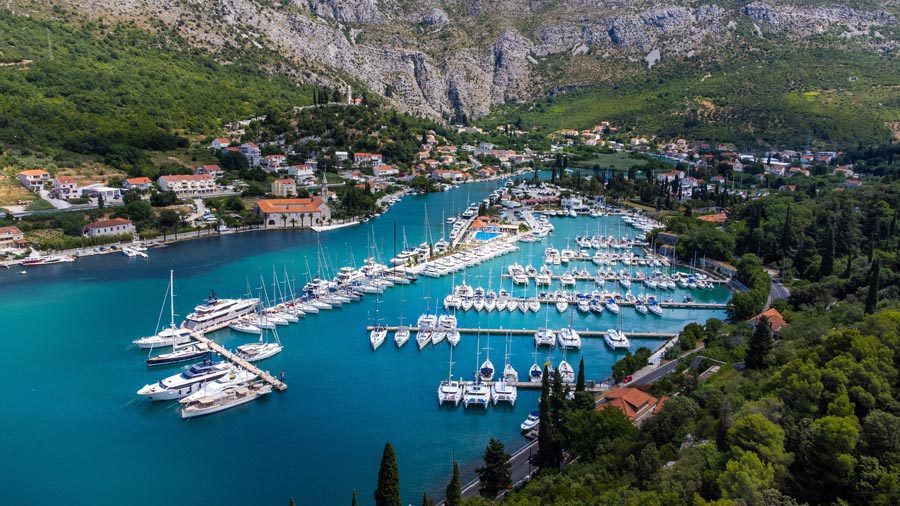
Why the catamaran works so well in the Adriatic
The Croatian coast rewards travellers who understand that distance is only one part of route planning. The more important question is how the day feels. On a monohull sailing yacht, the pleasure may come from sailing purity and heel under canvas. On a motor yacht, it may come from moving fast enough to redraw the map. On a catamaran, the pleasure lies in how comfortably the hours between destinations can be inhabited. Breakfast can happen at anchor. Children can move about more easily. Guests unused to boating are less preoccupied by motion. Lunch can stretch. The tender can become an extension of the beach club rather than a piece of logistics.
That matters particularly in Croatia, where many of the most attractive stops are not giant ports but modest harbours, pine-lined coves and elegant small towns whose best moments are experienced in fragments: a swim near Šipan, coffee on Korčula’s stone lanes, an afternoon drifting off Mljet, a quiet aperitif as the light changes on Cavtat’s promenade. A catamaran encourages precisely that kind of sequencing. It does not press the guest to maximize nautical mileage. It invites a more refined decision: fewer frantic crossings, more quality time in the places that count.
The other reason is social geometry. Croatia is one of Europe’s most successful group-travel charter markets because it appeals simultaneously to parents, grandparents, honeymooners, friendship groups and celebratory travellers. A catamaran’s twin-hull layout gives these mixed parties a degree of privacy that is difficult to underestimate. Cabins are usually separated more intelligently, circulation is easier, and outdoor living areas accommodate different tempos without conflict. One person can read, another can swim, another can work briefly online, and lunch can still feel collective rather than fragmented.
| Dimension | Luxury catamaran strength | What it means in Croatia |
|---|---|---|
| Deck living | Wide beam, multiple social zones | Guests can breakfast at anchor, lounge on the foredeck at midday, and dine on the aft deck without the boat ever feeling crowded. |
| Route logic | Shallow draft and stable platform | Useful around sheltered bays, small anchorages, and relaxed hop-by-hop cruising between the Elaphiti islands, Mljet, Korčula and Hvar. |
| Best for | Families, couples, groups of friends | A catamaran suits guests who want service, privacy and easy water access without the formality of a large motor yacht. |
| Design mood | Contemporary, open, resort-like | The experience feels closer to a floating villa than to a traditional sailing holiday. |
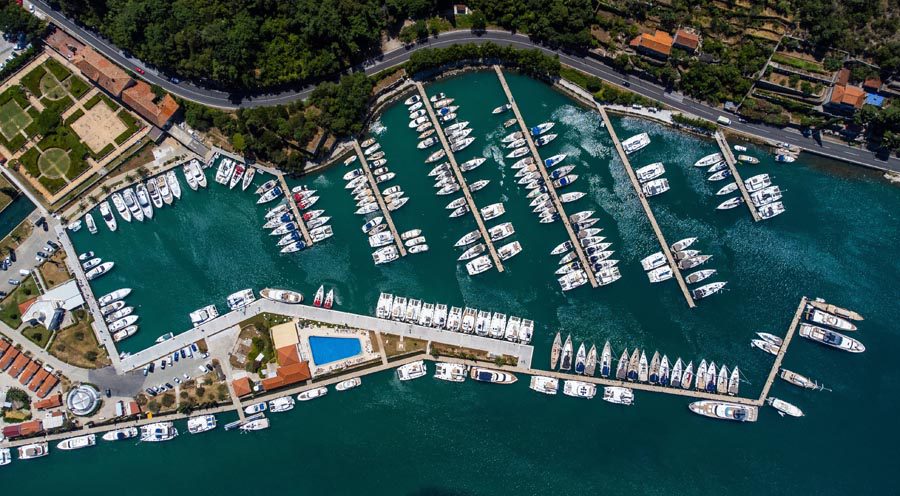
Design, comfort and the floating-villa effect
Luxury catamarans now sell less on technical merit than on atmosphere. The best examples in Croatia feel like floating villas with a maritime intelligence built into the plan. Saloons have become bright indoor-outdoor rooms. Galley-up layouts allow the chef or hostess to remain present within the life of the charter rather than disappearing below. The aft deck functions as a dining terrace. The flybridge, once an exposed perch, now acts as a sunset lounge and observation deck. This layered use of space is one reason catamarans have become so persuasive for travellers who might otherwise consider a shoreline hotel with day-boat excursions.
In the Adriatic, design details matter because the weather invites continuous outdoor living for much of the season. From late May through September, a successful charter product is one that manages shade, air flow and movement between water and deck gracefully. Wide bathing platforms make casual swimming more likely. Foredeck nets and sunpads alter the psychology of the day by giving the boat a true leisure front room. Cabins with proper natural light and ensuite bathrooms prevent the week from becoming a compromise between beauty outside and discomfort within. The better Croatian crewed catamarans understand that luxury today is not only about polished finishes but about reducing friction.
There is also a particular contemporary elegance to the category. A sleek crewed catamaran entering Cavtat or lying off a quiet bay near Mljet communicates a kind of understated prosperity. It does not carry the old-school theatricality of a classic gulet or the overt assertion of a large motor yacht. Instead it suggests ease, fluency and modern taste. For many international clients, especially design-conscious couples in their thirties to fifties, that tone is precisely the point.
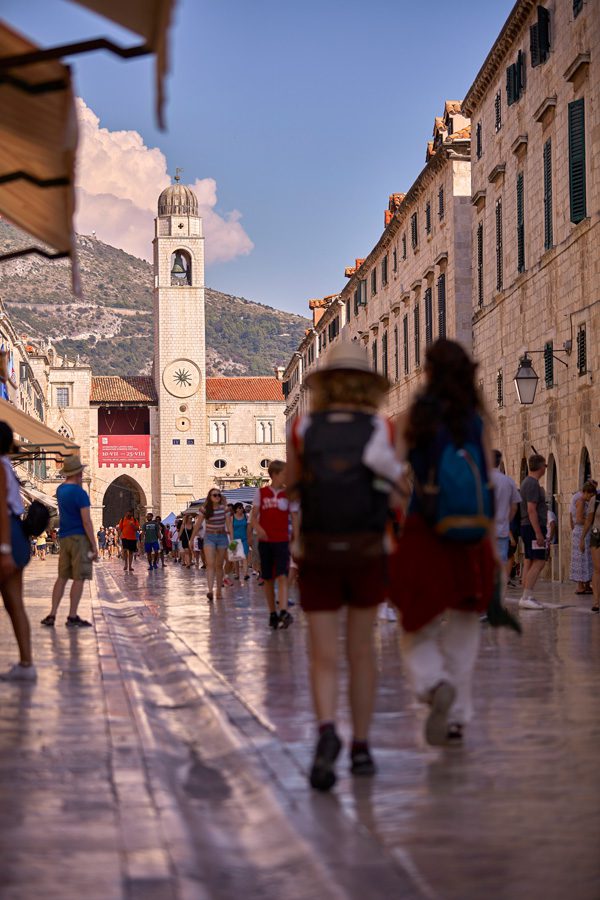
Who should charter one?
The strongest catamaran product in Croatia is rarely targeted at only one demographic. Families favor it because cabins tend to be evenly sized and deck circulation is forgiving for different ages. Couples choose it when they want privacy, a low-stress itinerary and the ability to combine swimming, dining and scenic cruising without overcomplication. Groups of friends are drawn to the social plan: everyone can gather naturally, yet no one is forced into permanent proximity. For multi-generational charters, the stability of the platform becomes part of the luxury proposition, especially for guests who enjoy the sea but are not hardened sailors.
Where it outperforms the alternatives
A luxury catamaran tends to outperform a monohull sailing yacht when comfort and social space are more important than sailing romance. It outperforms a gulet when guests want a more contemporary feel and easier access to modern marina infrastructure. It outperforms a motor yacht when the clients do not need to cover large distances quickly and would rather spend budget on crew quality, route length and onboard living than on fuel-heavy speed. In that sense, the catamaran is not a compromise product. It is often the most rational expression of Adriatic luxury.
It is especially convincing for clients new to charter. First-time guests often discover that what they feared about boating was never really about the sea itself, but about imagined discomfort, limited privacy or excessive technicality. A well-selected catamaran removes those barriers. The result is that many first-time Adriatic charterers who start on catamarans become long-term repeat clients because the initial learning curve was so gentle.
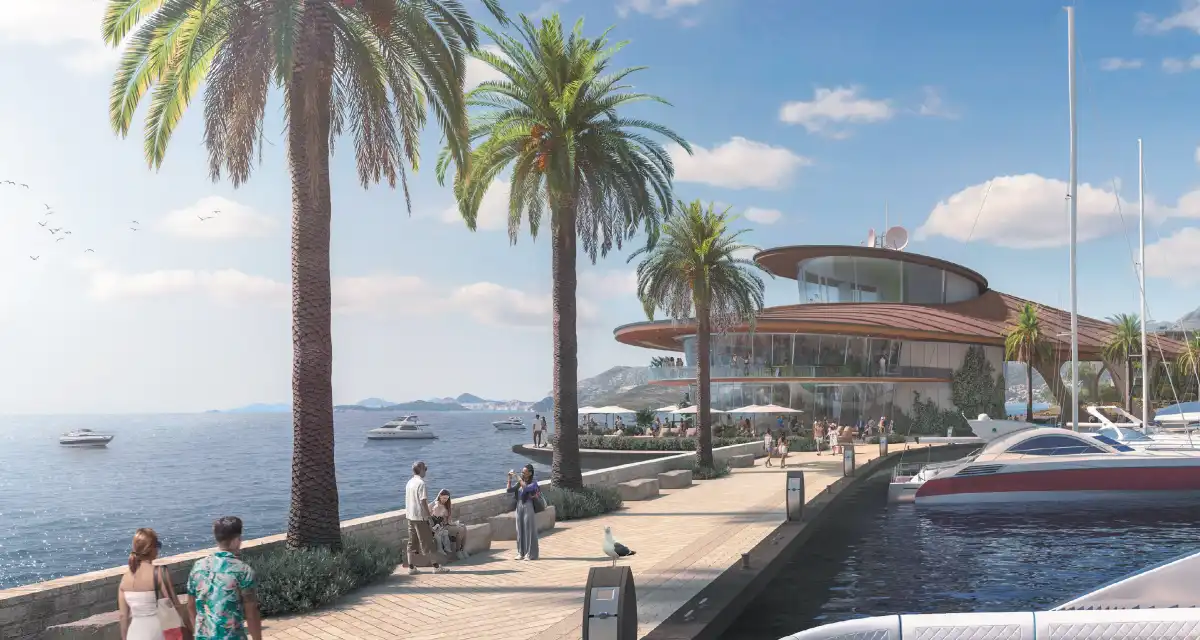
Southern routes from Cavtat and Dubrovnik
For travellers entering through the south, the catamaran is a highly persuasive way to structure a week because the itinerary can feel simultaneously cultivated and unhurried. Cavtat is particularly appealing in this regard. It offers proximity to Dubrovnik Airport, a more composed atmosphere than the city itself, and a waterfront mood that already feels attuned to yachting culture. From there, the opening days can be shaped around the Elaphiti islands, the wooded calm of Mljet, and the architectural satisfaction of Korčula. Montenegro extensions are possible for clients wanting Porto Montenegro and the Bay of Kotor, though that introduces border formalities and slightly different route priorities.
The essential appeal of a southern catamaran week is the way stone towns and swim stops alternate. Dubrovnik delivers theatre, but it is not the only note. A dinner ashore in Korčula, a lazy anchorage near Šipan, and a swim off Mljet create a charter product built around contrast rather than constant intensity. Because a catamaran handles these moderate legs so elegantly, the route never feels squeezed by the desire to rush onward.
This is where editorially minded travel planning matters. The best southern Adriatic catamaran charters are not designed by asking how many islands can be ticked off in seven days. They are designed by asking which sequence allows the sea, the towns and the onboard life to support each other. That is a fundamentally more luxurious question.
Split, Hvar and the central Dalmatian mood
From Split the category takes on a slightly different identity. The boating infrastructure is deeper, the fleet choice is broader, and the cultural expectations are more openly tied to the classic charter week. Hvar, Vis, Brač and Šolta create a rhythm of stylish harbours, restaurant-led evenings and open-water transitions. A luxury catamaran fits the central Adriatic particularly well because it can absorb both the social glamour of Hvar and the quieter intervals required to balance it.
For some travellers, this region is the archetypal Croatian catamaran ground. It offers recognisable names, dependable marina logistics and a strong mix of beach-club energy and sailing atmosphere. Yet the best use of a catamaran here is not to surrender to the busiest pattern. It is to use the boat’s flexibility to control mood. One night can be restaurant and harbour driven; the next can be entirely secluded, with dinner onboard and a long swim before sunset. That alternation is one of the reasons catamarans remain so commercially successful in Croatia’s most in-demand zones.
The category also handles shoulder season especially well in central Dalmatia. In June and September, when evenings are softer and towns less compressed, the boat becomes a wonderfully civilised base from which to move between more animated stops and quieter anchorages. For travellers seeking style without incessant scene-making, this may be the most satisfying formula of all.
Seasonality, timing and why the month changes the product
Croatia’s charter season also shapes how this product should be understood. June and September often flatter thoughtful travellers most because the water is warm, the service culture is fully awake and the coastline feels more breathable. July and August bring maximum social energy and the widest sense of the charter market as a summer stage, but they also demand more planning discipline. For luxury catamaran chartering, seasonality changes not only price and availability but mood. The same boat can feel serene in late June and far more performative in mid-August, not because the product changed, but because the Adriatic did. Sophisticated clients recognise this and book accordingly.
Shoulder season is particularly interesting because it reveals whether the yacht product has real integrity. When the heat is softer and the coast less compressed, the focus falls more clearly on layout, service and route intelligence. Boats that rely too heavily on the noise of peak summer are less impressive then. Boats with genuine comfort, good crews and well-proportioned itineraries often become even better. This is one reason repeat Adriatic clients so frequently migrate towards June and September after an initial peak-season experience.
Booking windows matter too. The strongest boats, especially those with good crews and a reputation for being well managed, tend to be secured earlier than first-time clients expect. That is true for catamarans, motor yachts, gulets and specialist family or privacy-led products alike. The market is mature enough that quality is usually recognised well in advance. In editorial terms, The key point is a charter should be treated as a designed travel experience, not a last-minute commodity. The best version of luxury catamaran chartering in Croatia is usually the version that was planned with foresight rather than assembled under pressure.
Common mistakes and the difference between visible and lived luxury
One of the most common mistakes clients make with luxury catamaran chartering is assuming that visible luxury automatically produces lived luxury. In Croatia, the lived version is built from finer decisions: how long the sea legs feel, whether lunch is being taken in the right place, how sensibly harbour exposure is managed, whether the crew understand when to serve and when to disappear, and whether the route leaves room for mood rather than only movement. These choices may seem secondary beside the yacht’s appearance, but in practice they decide the quality of the week.
Another error lies in overprogramming. The Adriatic is seductive because there are so many plausible names to include: Dubrovnik, Cavtat, Hvar, Korčula, Mljet, Montenegro, Split and many smaller islands besides. Yet luxury rarely improves through accumulation alone. A charter that tries to prove its worth through relentless movement usually diminishes the yacht as a place to live. The better strategy is to allow one or two strong notes per day, then leave enough unscheduled space for water, conversation, reading, lunch and the simple pleasure of being at sea.
That is also why editorial framing matters. Travellers often book more intelligently when the product is described in human rather than technical terms. They need to know not simply what the boat has, but how the week will feel. Luxury catamaran chartering should be understood through lived rhythm: mornings, transitions, swim stops, dining, light, privacy, motion and the emotional temperature of arrival. That is how serious travel decisions are made.
Market context: why Croatia keeps sharpening the category
The broader Adriatic market gives additional context to luxury catamaran chartering. Croatia has become one of Europe’s most legible charter destinations not only because it is beautiful, but because it supports multiple levels of sophistication at once. There are straightforward sailing weeks, heavily social routes, highly private itineraries, family-led charters, design-focused catamaran trips, heritage-driven gulet holidays and modern motor-yacht programs. This breadth makes Croatia unusually useful for comparison. It allows travellers to refine taste, not just consume scenery.
For that reason, the country increasingly attracts guests who are not merely renting a boat for the first time, but actively learning what kind of maritime traveller they are. Some discover that they value the sea itself; others discover that they value privacy, hosting, architecture, gastronomy or the elasticity of route. Luxury catamaran chartering sits within that wider education. It is not a standalone product category floating above context. It is part of a mature ecosystem in which Cavtat, Dubrovnik, Split, Hvar, Korčula and Montenegro each contribute different tones to the market.
This is also why the best charter content should avoid brochure language. The Croatian yacht landscape is now too developed, and its clients too informed, for empty superlatives to be useful. What serious travellers want is interpretation. They want to know what a yacht product represents, what kind of people tend to love it, where it works best, and how it speaks to the Adriatic itself. Any honest analysis of luxury catamaran chartering has to start there. In Croatia, a luxury catamaran succeeds because it turns island-hopping from a transport problem into a lifestyle: spacious, stable, sociable and quietly architectural.
Conclusion
The enduring strength of the luxury catamaran charter in Croatia is that it aligns almost perfectly with the country’s geography and with how contemporary travellers actually want to move. Guests do not merely want to sleep on a boat. They want to inhabit a week in which every transition feels deliberate: a calm embarkation, a good lunch at anchor, a handsome arrival into a stone harbour, a comfortable cabin, a deck that feels social but not crowded, and a crew who understand that elegance often lies in removing effort from the day.
For readers exploring the yachting sections of Cavtat Guide or browsing related experiences, the category deserves attention not as a trend but as one of the most coherent premium travel products in the Adriatic. It suits the style of southern routes from Cavtat and Dubrovnik, it thrives on the central Dalmatian circuit through Split and Hvar, and it continues to evolve in design quality. Stylish island-hopping is not an empty phrase when the product is chosen well. In Croatia, it often means a luxury catamaran.
Need help choosing the right experience?
Tell us your budget, dates, and travel style, and Cavtat Guide will help you choose the best yacht charter, tour, property option, or local experience.