

Updated for 2026
Dubrovnik was never merely a filming backdrop for Game of Thrones. It worked as King’s Landing because the city already possessed what fantasy needed: authority, stone, command, gates, cliffs, and the architectural language of power. This guide is built for visitors who want more than a loose list of shooting locations. It is designed as a proper walking-and-planning route, so you can experience Dubrovnik’s most important Game of Thrones sites in an order that feels cinematic, legible, and physically realistic.
Main takeaway: The smartest Game of Thrones day in Dubrovnik is not a frantic photo hunt but a clean walking sequence through the city’s most important King’s Landing locations.
Best for: first-time visitors, serious fans, photographers, and Cavtat-based travellers who want one highly structured Dubrovnik day.
Best planning logic: do the core Old Town circuit early, then add Lokrum or Trsteno only if time and energy still justify it.
King’s Landing in Real Life: The Definitive Game of Thrones Guide to Dubrovnik
A complete walking-and-planning guide to Dubrovnik’s most important Game of Thrones locations, from Pile Gate and Fort Lovrijenac to the Jesuit Staircase, Lokrum, and Trsteno with route logic that keeps the city cinematic rather than chaotic.
This is the guide for people who want the exact stones — the gates, stairs, walls, and forts that gave King’s Landing its authority — without turning Dubrovnik into a frantic checklist. You’ll get a clean walking route through the Old Town, the smartest beyond-the-walls add-ons, and the timing logic that makes the city feel cinematic instead of crowded.
Dubrovnik played multiple roles in the series, but one thing stayed constant: it gave the show a capital with genuine authority. That is why the city works so well on screen. The walls are not props. The gates are not decorative. The forts are not fantasy. They were built to control movement, protect the harbour, and make power visible long before television arrived.
That matters because the smartest Game of Thrones day in Dubrovnik is not a scavenger hunt. It is a way of understanding why the city felt believable as King’s Landing in the first place. The more clearly you read the urban logic — fortress, gate, staircase, harbour, skyline — the more the filming locations stop feeling like random spots and start feeling like one coherent capital.
The King’s Landing protocol: how to do this properly
Pick your light. If you want the city at its most cinematic, aim for 7:30–9:00 in the morning or the last two hours before sunset. Early light gives you quieter streets and softer stone. Late light makes the walls glow and the harbour read like theatre.
Wear real shoes. Dubrovnik’s polished limestone is beautiful and unforgiving. If your plan includes the walls, Fort Lovrijenac, and the Jesuit Staircase, treat the day like a scenic walk with a medieval skyline rather than a casual city stroll in decorative footwear.
Choose your mode. You can do this self-guided, on a dedicated walking tour, or as a city-and-island combination. The smartest version for most visitors is self-guided in the morning, then one add-on Lokrum or Trsteno later in the day.
Do not try to beat Dubrovnik. The Old Town is compact, but crowd pressure can build quickly. The solution is not speed. It is sequencing. Hero locations early. Side streets and shade at peak hours. Then a second pass later when the city softens again.
Quick strategy: start at Pile Gate, take Lovrijenac early, use midday for shade or a break, and save the Jesuit Staircase and harbour edge for later light whenever possible.
The core circuit: Dubrovnik’s essential King’s Landing locations
For most visitors, the goal is simple: move through the Old Town in a sequence that makes physical sense. Start at the gate, work the spine of the city, then branch out to the fort, the harbour edge, the staircase, and the skyline command point. This makes the city read as one coherent capital rather than as disconnected filming pins on a map.
1) Pile Gate: the capital’s front door
Real place: Pile Gate, the main western entrance to the Old Town. Why it works on screen: gates are always theatre. They compress movement, build pressure, and make every arrival feel consequential.

Do this: walk the bridge slowly, look up at the layers of fortification, and resist the instinct to rush straight down Stradun. Take one side lane first. It changes the city from spectacle into place.
That small detour is worth more than it sounds. The moment you leave the main current of visitors and step into one of Dubrovnik’s quieter lanes, the filming-location mindset improves. You stop searching only for scenes and start understanding how the city breathes between them.
2) Stradun: the limestone runway
Real place: Stradun, the main street of the Old Town. Screen function: the spine of the capital, where public space and public judgment become the same thing.
Walk it twice: once to orient yourself, and once slowly enough to notice the symmetry, the proportions, and the merchant-republic confidence built into the street. It is not only beautiful. It is controlled. That is why it works so well in fantasy television. It already knows how to stage power.
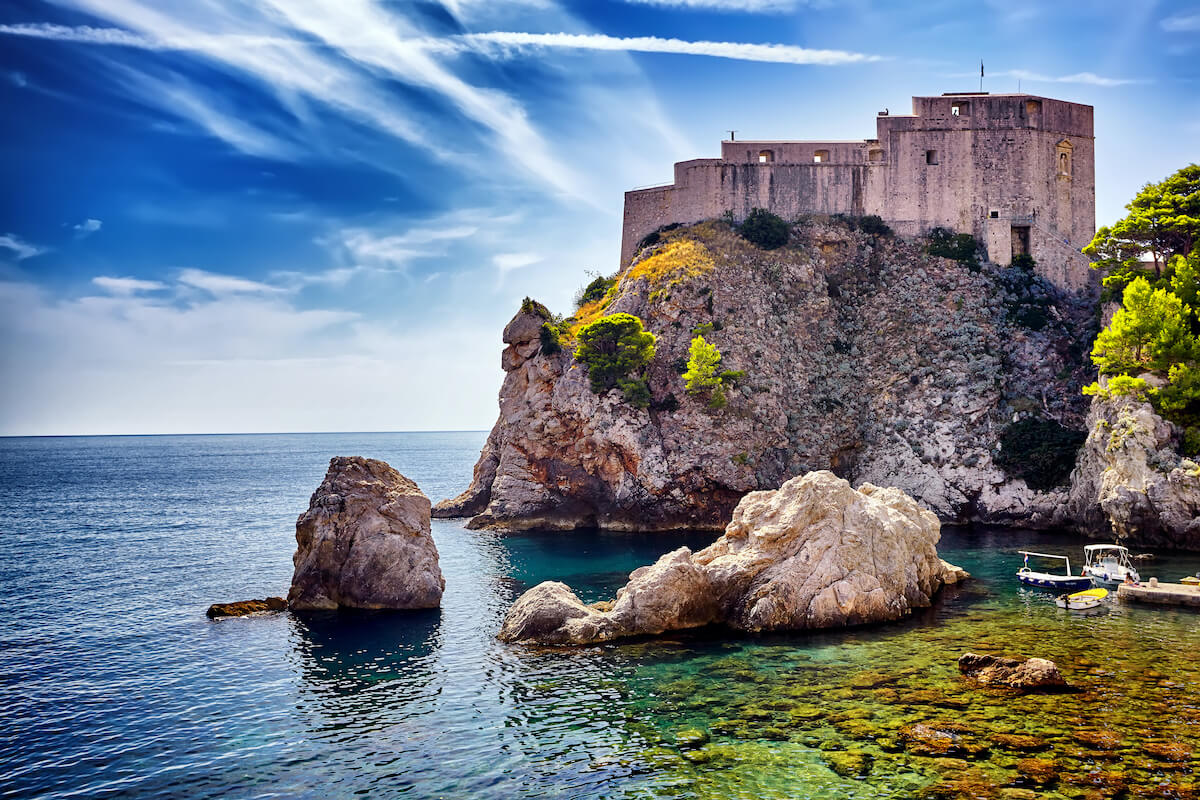
3) Fort Lovrijenac: the Red Keep’s attitude
Real place: Fort Lovrijenac, outside the western walls on a cliff. Screen energy: power watching power. The fort stands apart from the city, yet protects the same promise.
Do this: walk the outer edge and look back at the walls. Frame the fort and city together. That relationship is the point.
If you photograph only the fort in isolation, you miss the real geometry of the place. Lovrijenac matters because it is both inside the Dubrovnik story and slightly outside it. In Game of Thrones terms, that tension is exactly what gave it Red Keep gravity.
4) West Harbor / Kolorina: Blackwater Bay without invention
Real place: the sea-facing pocket below Lovrijenac, often called Kolorina or West Harbor. Screen energy: water, walls, vulnerability, arrival pressure.

Do this: come in late afternoon if you can. The light is kinder, the water glows, and the whole bay feels more cinematic than at midday.
This is one of the strongest places in the entire route for understanding why Dubrovnik was such an asset to the production. At sea level, the city becomes less postcard and more fortress. The harbour, cliffs, and outer walls feel genuinely strategic.
5) The city walls: the master key
The walls are essential — but only if you do them intelligently. They are the most famous, hottest, and most physically demanding part of the route. Go early or late. Do not race. The best moments are the pauses: a tower shadow, a sudden view down to the sea, and the feeling that the whole city folds inward like terracotta surf.
If you begin at the wrong time, the walls can feel like a queue with scenery. If you begin at the right time, they feel like the master key to Dubrovnik. Suddenly every gate, tower, staircase, and harbour line starts making sense.
6) Jesuit Staircase: the city staging humiliation through stone
Real place: the Jesuit Staircase near St. Ignatius Church. Screen effect: humility forced by architecture. The steps are symmetrical, steep, and impossible to ignore.

Do this: come early for clean photos or later when the light softens and the stairs regain some of their theatrical dignity.
They are worth experiencing from both directions. Seen from below, the staircase has force. Seen from above, it reveals how Dubrovnik choreographs ascent and descent through stone. It is one of the clearest examples of real architecture doing cinematic work without needing embellishment.
7) Minčeta Tower: skyline command post
Real place: Minčeta Fortress. Why it matters: if you want one place that explains Dubrovnik’s defensive logic, it is here. Outward sea, inward city, total oversight.

This is where the skyline stops being romantic and starts making sense. From here, the city reads as system rather than scenery. That is why Minčeta belongs in every serious King’s Landing route even if you are not obsessively scene-matching every shot.
| Location | Why it matters | Best timing | Main caution |
|---|---|---|---|
| Pile Gate | Best opening move and cleanest city entry | Early morning | Rush-hour compression once the city fills |
| Stradun | Explains Dubrovnik’s public stage logic | Early or late | Can feel flattened if only rushed through once |
| Fort Lovrijenac | Strongest “Red Keep” energy | Morning | Heat and steps if done too late |
| West Harbor | Best water-and-walls relationship | Late afternoon | Harsh midday light |
| Jesuit Staircase | Most recognisable single stair location | Early or evening | Crowds in the middle of the day |
| Minčeta Tower | Best skyline command point | Early if on the walls circuit | Can feel physically heavy in summer heat |
Beyond the walls: Lokrum and Trsteno
If the Old Town is your capital, Lokrum is your exhale. Trsteno is your garden of strategy. Together they deepen the Dubrovnik story without exhausting it.
Lokrum Island: the city’s fastest reset button
Lokrum sits just off Dubrovnik like a green punctuation mark. It is pine-scented, walkable, close enough to the city to feel connected, and far enough to calm the nervous system. For Game of Thrones visitors, it also matters because Lokrum stood in for Qarth, with scenes associated with the monastery and garden atmosphere.
After hours of stone, gates, and vertical movement, Lokrum’s greenery feels like structural relief. It does not compete with Dubrovnik. It improves it by giving your eyes and feet another register.
Trsteno Arboretum: where politics hides behind gardens
Trsteno feels older than tourism. Stone terraces, fountains, shade, and an atmosphere built for plotting. It is strongly associated with the show’s garden-politics aesthetic and is worth the trip even if you care more about Dubrovnik than Westeros.

Do this: pair it with a wider half-day coastal plan rather than forcing it into the same tight window as your full Old Town route.

Trsteno is especially good for visitors who prefer atmosphere over density. If the Old Town is your concentration of power, Trsteno is the political aftertaste: the place where conversations seem to matter more than crowds.
Itineraries that actually work
1-day King’s Landing version
Morning: Pile Gate → Stradun → Fort Lovrijenac → West Harbor.
Midday: either walls if you started early, or a long shaded lunch if the heat is building.
Afternoon: Jesuit Staircase + Minčeta.
Evening: return for golden-hour photos and a calmer dinner inside or just outside the walls.
2-day fan-plus-holiday version
Day 1: Old Town core + Lovrijenac at an intelligent pace.
Day 2: Lokrum or Trsteno, then the walls at the quietest possible time window. Your feet will forgive you, and your photos will look less desperate.
Best version for Cavtat-based travellers
Morning: arrive in Dubrovnik early and do the core circuit before the city compresses.
Midday: pause instead of forcing hero shots in the hardest light.
Late afternoon: one final location pass, then return to Cavtat for dinner and recovery.
Why it works: you get King’s Landing properly without needing to sleep inside it.
Where Cavtat fits in
Dubrovnik is essential, but it is not always the best place to sleep if you want calm. If you want the King’s Landing day without the King’s Landing stress, base yourself in Cavtat: easier arrivals, quieter mornings, and a genuine sea-air reset at night. Treat Dubrovnik as a mission, not a base, and the whole trip becomes more elegant.
This matters particularly for travellers who love the city on screen but do not necessarily want to manage its pressure for several nights in a row. Cavtat solves that problem quietly. You still get Dubrovnik’s drama when you choose it, but you sleep somewhere that feels like release rather than continuation. Use our Cavtat vs Dubrovnik comparison if you are still deciding how to structure the wider stay.
Practical intelligence: crowd math, heat math, and timing
Crowd math is real. Dubrovnik’s Old Town is compact. When cruise passengers and day-trippers hit at once, the streets do not merely feel busy — they compress. If you notice that compression, change mode: do shade, side streets, a slower lunch, or a short break rather than trying to force the hero shots through maximum pressure.
Heat math is real too. The limestone reflects light upward. In summer, the city can feel like it is lit from below. If you are doing walls, fort, and staircase in one day, build in a real midday pause. Water, shade, and a proper stop will save the second half of the route.
From Cavtat: bus, taxi, private transfer, and seasonal boat all work depending on the time of year. The smoothest day usually looks like this: early arrival, one structured Old Town mission, then a calmer return once the city has stopped pushing back so hard.
| Time window | What Dubrovnik feels like | Best use |
|---|---|---|
| 07:30–09:30 | Most legible, quietest, best light | Pile Gate, Stradun, walls, Lovrijenac |
| 10:30–15:30 | Brighter, hotter, more compressed | Shade, lunch, side streets, Lokrum, slower reset |
| 17:30–20:00 | Softer, more photogenic, calmer | Jesuit Staircase, harbour edge, second photo pass |
| After dark | Cooler, more atmospheric, less performative | Old Port, final walk, quieter city loop |
Bonus deep cuts
Mount Srđ: all of King’s Landing at once
If you want the single panoramic view that explains why Dubrovnik worked so perfectly on camera, this is it. From above, the city stops being a collection of sights and becomes one coherent machine: walls, harbour logic, terracotta density, island punctuation, and sea.
Sea-level perspective
You do not need to be an athlete to appreciate the maritime logic of Dubrovnik. Whether by boat approach, harbour edge, or coastline route, the city becomes much more convincing once you understand how strongly it is designed to meet the water.
Old Port at night
One of the best free moves is also the simplest: return after dark. The limestone cools, the crowd pressure drops, and the city regains some of the low-lit dignity that made it feel so convincing on screen.
Eat and drink without falling into tourist theatre
Dubrovnik has plenty of good food, and plenty of places trading purely on address. Two rules usually keep you safe: if the menu feels like it was written for an airport, keep walking; if the host is working too hard to pull you in, keep walking.
The simple win is a side-street konoba, a glass of something cold, and one honest Dalmatian dish after the heat breaks. You are already getting the fantasy from the city itself. Dinner does not need to cosplay.
This is especially relevant on a themed day. When travellers are already carrying scene references, maps, and timing strategy in their heads, the best meal is usually the one that returns Dubrovnik to reality for an hour. Stone, shade, a good plate, and less performance than the city already provides for free.
What most visitors get wrong
The biggest mistake is treating Dubrovnik like a set rather than a city. That produces bad timing, weak routes, and too much attention to isolated frames. The stronger approach is to let the filming locations sit inside the real urban logic. The gate leads somewhere. The staircase joins districts. The fort answers the harbour. The walls explain the town.
The second mistake is overloading the day. If you try to combine full walls, Lovrijenac, Lokrum, Trsteno, a guided tour, and a dinner reservation without slack, King’s Landing will feel less like a fantasy capital and more like an exhaustion test. Choose structure over quantity. Dubrovnik rewards that discipline.
Final word
The smartest way to do King’s Landing is to remember that Dubrovnik was never built to entertain. It was built to endure. That is why it reads so well on camera. The gates are not props. The fort is not scenery. The staircase is not a meme. The city is older than the fiction, better than the fiction, and more interesting the moment you stop trying to make it behave like a set.
So take the photos. Find the scenes. Then look up from the reference image and let Dubrovnik do something television never could: behave like itself. That is when the guide stops being fan service and starts becoming travel intelligence.
Plan and sources
- Dubrovnik Tourist Board: Lokrum and Qarth association
- Official events calendar (Konavle/Cavtat)
- Dubrovnik Tourist Board
Related reading
- The 4-Hour Miracle: Cavtat’s Blue Cave & Elaphiti Speedboat Tour
- Hotel Croatia, Cavtat: The Cliffside Grande Dame — A Full, Honest Review
- Top Things to Do in Cavtat in 2026
- The Best Day Trips from Cavtat and Dubrovnik
Need help choosing the right Dubrovnik or Cavtat experience?
Tell us your dates, budget, and travel style, and Cavtat Guide will help you combine Dubrovnik location days with the right water taxi, panorama cruise, private charter, or Cavtat-based stay plan.