Hotel Dubrovnik Palace occupies a distinct position within the accommodation map of the Dubrovnik Riviera. In practical traveler terms, that matters more than star classification alone. Luxury on this coast is never just about thread count, spa menus, or whether a lobby looks expensive in photographs. It is about how a property interprets geography: whether it sits inside the city’s pressure, above it, beyond it, or in deliberate retreat from it. Hotel Dubrovnik Palace is one of those hotels that reveals how sharply a setting can shape the mood of an entire stay. Rather than functioning as a neutral base, it acts as an argument about what Dubrovnik, or the wider Riviera, ought to feel like for the guest who books it.
For Cavtat Guide readers, the essential question is not whether Hotel Dubrovnik Palace is ‘good’. It is what kind of stay it produces, what kind of traveler it rewards, and how honestly its public image matches the lived rhythm of days spent there. That means looking at architecture, circulation, dining, noise, sea access, transfer logic, visual drama, and the subtle but decisive difference between wanting to be near Dubrovnik and wanting to be in Dubrovnik. It also means placing the hotel inside a competitive field that now includes city grandees, clifftop boutiques, modern international resorts, and increasingly ambitious Adriatic properties beyond Croatia itself.
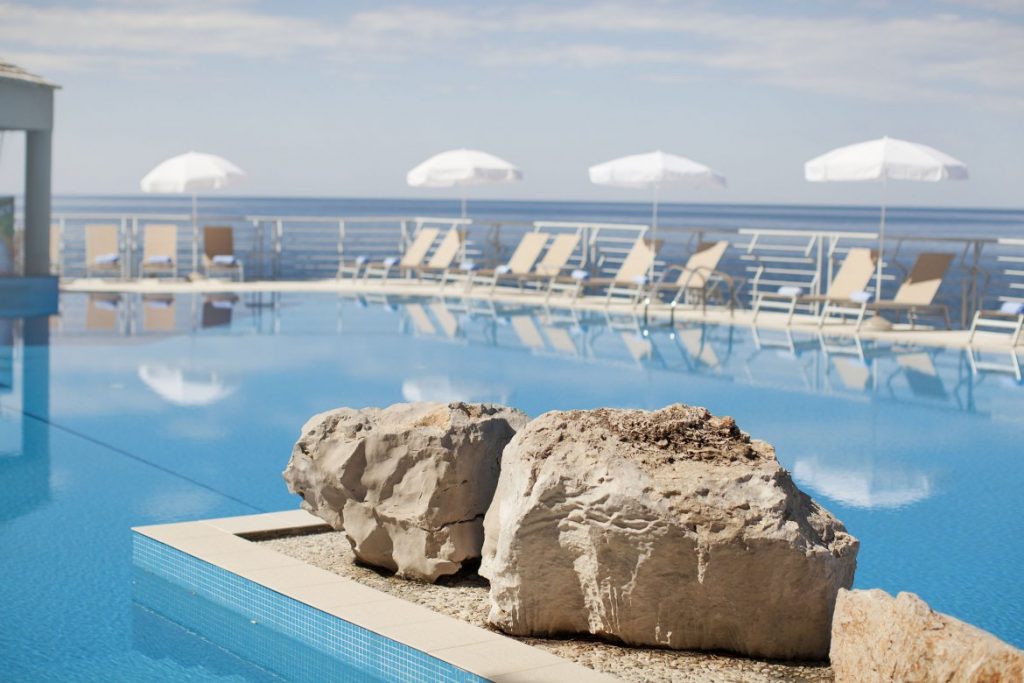

Why this hotel matters in the Dubrovnik Riviera conversation
The Dubrovnik Riviera is often discussed as though it were a single market. In reality it is a chain of different coastal conditions. The walled city concentrates prestige, density and symbolic capital. Lapad offers distance and resort space while keeping Dubrovnik in reach. Srebreno and Mlini mediate between city access and village ease. Cavtat operates with a more complete sense of town life and airport convenience. Properties like Hotel Dubrovnik Palace matter because they help travelers decide which of those conditions they actually want. A poor match can make a costly holiday feel awkward; the right match can make even familiar destinations feel newly legible.
In the upper segment of the market, guests are rarely comparing only room categories. They are comparing how mornings unfold, how often taxis are required, how quickly they can reach the sea, whether public rooms feel ceremonial or relaxed, and whether evenings end in a quiet bay or in the afterglow of the Old Town. Hotel Dubrovnik Palace belongs to the group of hotels that can only be understood properly when those questions are asked in sequence. That is why it deserves a full editorial treatment rather than a thin summary.
Verified facts and official positioning
The following points come from official hotel or operator material and form the factual basis for this review:
- Official material says every room has Adriatic views.
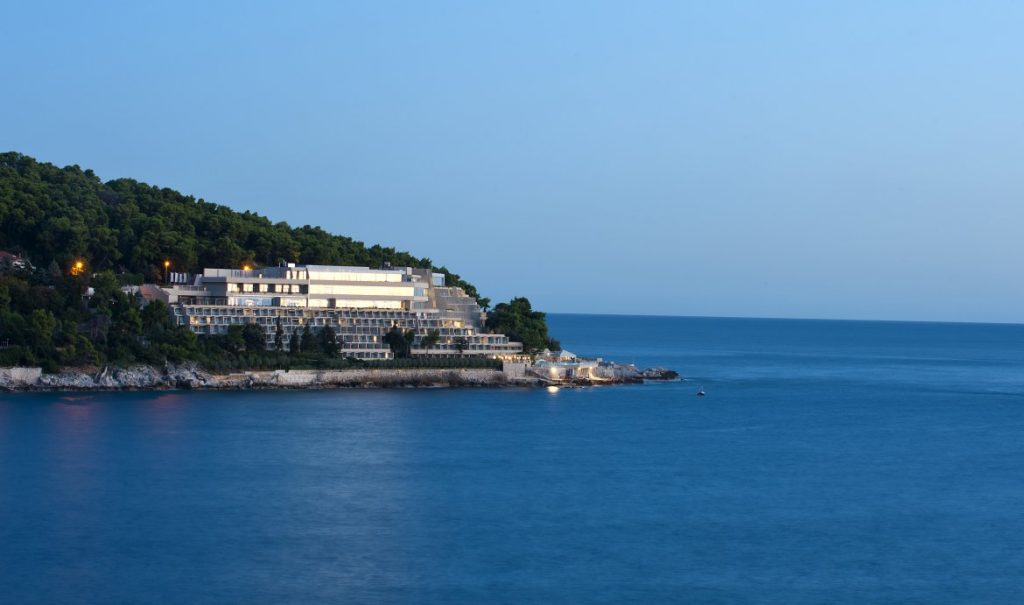
- The hotel stands on the seafront between Petka hill woodland and the sea on the Lapad peninsula.
- It has direct access to a quiet beach, two outdoor pools and one indoor pool.
- The property also lists a PADI diving centre and padel court.
- Official material puts the hotel 4.5 km from Dubrovnik Old Town and 22 km from the airport.
The best Dubrovnik Riviera hotels do not merely provide beds with sea views; they organise the traveller’s entire understanding of the coast.
Architecture, arrival, and first impressions
Architecture in Riviera hospitality is not decoration. It is logistics made visible. A guest reads a building before reading a room. Wide terraces imply lingering; steep vertical circulation implies drama; deep lobbies imply conference scale; low-slung sea-facing wings imply retreat. Hotel Dubrovnik Palace communicates its identity almost immediately through the relationship between built form and coast. The crucial question is whether the architecture asks the guest to look outward, inward, upward, or back toward the city. In the case of this property, the answer shapes everything from the first coffee to the final transfer.
Arrival matters especially in this region because the emotional handover from airport road to coastal hotel is often abrupt. Some properties convert that transition into serenity; others convert it into theatre. The best ones do both. A strong arrival sequence does not simply impress. It tells the traveller how to behave once inside: whether to slow down, dress up, stay put, go wandering, or use the hotel as a launch pad. Good hospitality design gives those instructions without ever speaking them aloud.
How the building meets the landscape
On this part of the coast, landscape is never passive background. Sea, rock, slope, pine, promenade and vehicular access all exert pressure on the final hotel experience. Hotel Dubrovnik Palace gains much of its character from how decisively it acknowledges that pressure rather than hiding it. The result is not generic Mediterranean luxury but a distinctly Adriatic version of it: sharper light, more dramatic relief, and an ongoing conversation between protected interior space and exposed waterfront outlook.
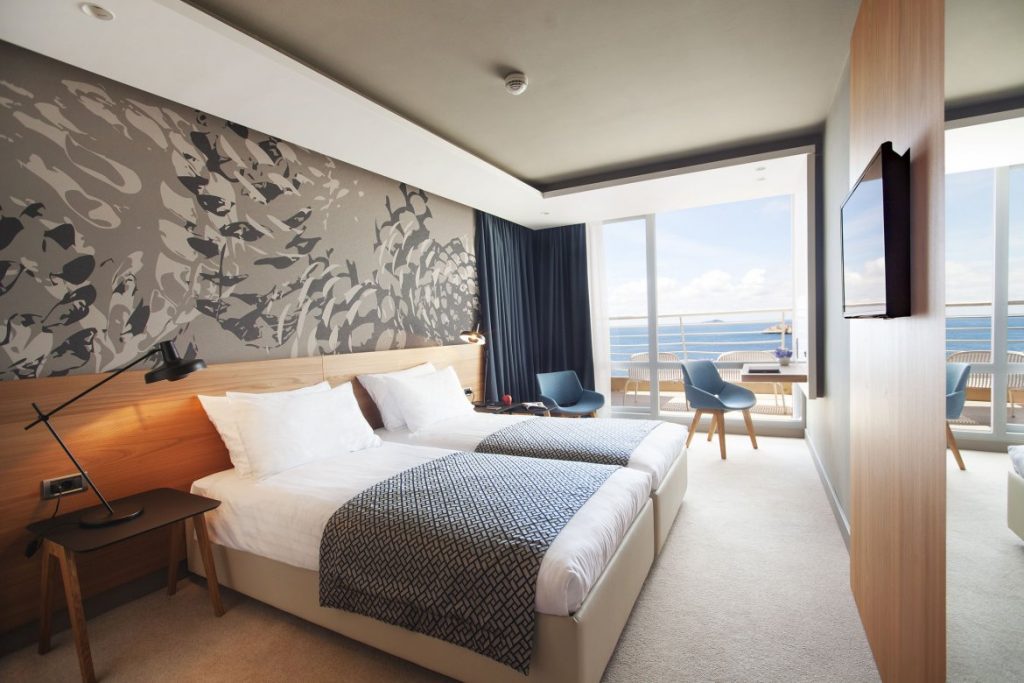
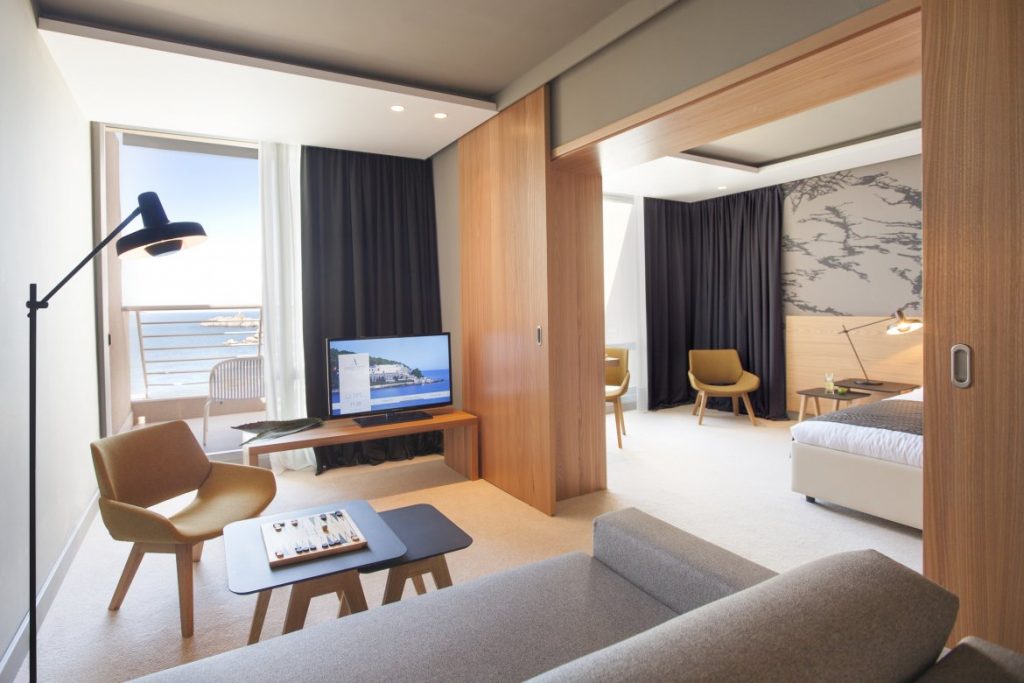

Rooms, privacy, and the practical shape of a stay
Travellers often underestimate how much hotel choice is really room-choice logic in disguise. A city-fringe hotel can succeed because the room becomes a place of recovery after sightseeing. A resort-edge hotel succeeds because the room extends the landscape rather than shutting it out. A boutique cliffside property succeeds when privacy feels intentional rather than constrained. Hotel Dubrovnik Palace needs to be assessed on those terms: not abstract luxury, but what happens when a guest returns at three in the afternoon, again at sunset, and once more after dinner.
This is where many superficially similar properties diverge. Some offer sea views but not enough usable outdoor space. Some have visually impressive rooms that do not work well for long mornings or remote work. Others provide scale without intimacy, or intimacy without enough storage, daylight or circulation. The strongest upper-tier hotels on the Riviera understand that guest comfort is cumulative. Noise control, bathroom generosity, balcony depth, and the quality of sightlines all matter more over four nights than any single headline amenity.
In editorial terms, Hotel Dubrovnik Palace makes sense when the room is treated as part of the destination. That is particularly important for couples, honeymoon travellers, return visitors and anyone who does not want to spend every hour in transit between attractions. A successful room here should invite pause rather than merely facilitating sleep.
Dining, public rooms, and service culture
Luxury hotels on the Adriatic are judged publicly by views, yet remembered privately by service rhythm. Dining reveals that rhythm faster than any other department. Breakfast organisation, terrace handling, pace between courses, and the tone of host interaction say far more about a property than a polished check-in ever can. The best hotels in this region understand that guests want polish without stiffness, knowledge without performance, and attention without interruption.
Hotel Dubrovnik Palace should therefore be read through its public rooms as much as through its accommodation. Restaurants, bars and lounges are where a property proves whether it has a mature identity or merely a good setting. On the Riviera, the dining room is often where the sea and the social world meet: where morning excursion planning, late-afternoon decompression and evening ritual all happen in the same visual field. If those spaces are scaled well, the guest feels carried through the day. If not, even an expensive hotel can feel oddly disjointed.


Seasonality, booking logic, and how to use the hotel well
A useful hotel review should also explain timing. The Riviera is not experienced in the same way in early spring, high summer, late September and the quieter shoulder weeks. A property with indoor wellness, strong public rooms and convincing views often gains relative value outside peak beach weather because the hotel itself carries more of the day. A resort whose strength lies in expansive outdoor leisure spaces may feel most persuasive when guests intend to spend long hours poolside or on nearby beaches.
That is where Hotel Dubrovnik Palace should be considered strategically. Travellers booking a short, high-impact first visit may prioritise visual immediacy and efficient orientation. Returning guests may care more about calm, room comfort and the ability to modulate between activity and retreat. Families may place transfer ease and reliable amenities above symbolic address. Couples may do the reverse. The hotel works best when booking motives are explicit, not improvised after arrival.
The key point is the Dubrovnik area can be unusually unforgiving of vague planning. Summer roads tighten, parking is awkward in many places, and the emotional cost of unnecessary transfers accumulates quickly. A carefully chosen hotel eliminates friction before it has the chance to become part of the holiday memory.
Who should stay here, and who should look elsewhere
No single luxury property suits every traveler. That is especially true around Dubrovnik, where the emotional difference between Old Town immersion, peninsula seclusion, bayfront resort ease and village calm is significant. Hotel Dubrovnik Palace is best understood as a deliberate choice rather than a universal recommendation. It will suit travelers whose priorities align with its setting and operational style. For some, that may mean proximity to the city with a strong sense of ceremony. For others it may mean wider resort infrastructure, calmer swimming conditions, or easier family logistics.
Travelers who want to walk out into bars, museums and dense urban atmosphere multiple times per day should be honest about how much transfer friction they are willing to accept. Travelers who imagine long breakfasts, spontaneous swims, slow terrace afternoons and restful evenings should be equally honest about whether they really want to stay in the city core at all. Luxury becomes much more satisfying once these preferences are admitted instead of disguised.
At a glance
| Editorial lens | Assessment |
|---|---|
| Setting | This property is defined first by where it sits on the coast and how that position shapes arrival, views and daily rhythm. |
| Best for | Travellers who choose accommodation as part of the story of the trip rather than as a place merely to sleep. |
| Less ideal for | Visitors whose priority is only price, or who want the opposite rhythm to the one the hotel naturally creates. |
| Key strengths | Geographic clarity, visual identity, and a hospitality proposition that is easy to understand once on site. |
| Choice logic | The decision to stay here should be made in relation to Dubrovnik, Cavtat, Mlini and the wider Riviera, not in isolation. |
How this property compares within the wider Riviera
The Riviera comparison set matters because guests rarely choose Hotel Dubrovnik Palace in a vacuum. They are choosing against at least three alternatives: the prestige of central Dubrovnik, the space and infrastructure of outer-edge resorts, and the more humanly scaled calm of places such as Mlini, Srebreno and Cavtat. Each alternative carries its own compromise. The great virtue of a well-positioned hotel is not that it eliminates compromise; it is that it makes the compromise worthwhile.
From an editorial perspective, the region is currently defined by divergence. Some hotels double down on history and symbolic location. Some foreground architecture and boutique privacy. Some rely on international brand consistency and resort breadth. Others succeed through village rhythm and understated coastal ease. The experienced traveler should choose according to desired tempo, not only according to photographs or loyalty points.


What real travelers should understand before booking
The most useful advice is simple: book the coast you want, not merely the room you can afford. Ask where you plan to swim, how often you need the city, what kind of evenings you prefer, and whether your trip is built around movement or around staying put. On the Dubrovnik Riviera, those are hotel questions as much as destination questions.
If you understand that distinction, Hotel Dubrovnik Palace becomes easier to read. Its strengths are meaningful when aligned with the right traveler profile. It is not simply a backdrop for glossy images; it is an instrument for structuring a certain kind of Adriatic holiday. That is the difference between a hotel that photographs well and a hotel that continues to feel right on the third and fourth day.
Conclusion
Hotel Dubrovnik Palace deserves attention because it clarifies the hotel logic of its stretch of coast. It shows, in its own way, how the Dubrovnik Riviera is not one destination but a sequence of coastal choices with different social, architectural and emotional outcomes. Travelers who understand those distinctions are far more likely to book well and travel well.
In the end, the value of Hotel Dubrovnik Palace lies in coherence. Setting, architecture, service expectations and guest rhythm all point in the same direction. That coherence is what sophisticated travelers pay for, even when they do not name it explicitly. And it is why serious hotel writing on this region must go beyond star ratings and into the lived mechanics of the stay itself.
Need help choosing the right experience?
Tell us your budget, dates, and travel style, and Cavtat Guide will help you choose the best yacht charter, tour, property option, or local experience.